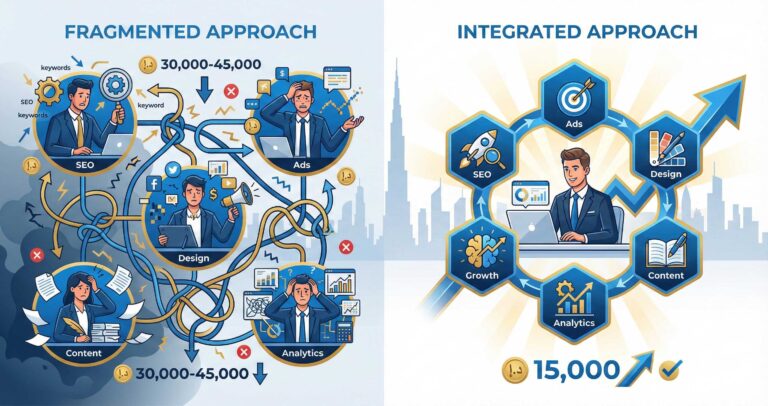

Most Dubai businesses pay AED 30,000+ monthly coordinating 5 different agencies—an SEO team, content writer, web designer, ads manager, and CRO specialist. None of them talk to each other.
The result? Disconnected strategy, wasted budget, and mediocre results.
I’ve spent 6+ years replacing these fragmented agency setups for Dubai businesses across real estate, healthcare, and e-commerce. The difference is dramatic. When I optimized a Dubai real estate client’s strategy with full-stack digital marketing in 2024, traffic grew from 50 to 44,800 monthly visits in 6 months. For a healthcare recruitment agency, I generated 180% more qualified leads while reducing cost-per-application by 45%. An e-commerce furniture store saw 85% sales increase in their first quarter.
These results weren’t magic. They came from one integrated system where every marketing channel works together from day one—no coordination overhead, no conflicting strategies, no finger-pointing when things go wrong.
In this guide, I’ll show you exactly why the traditional multi-agency approach costs Dubai businesses AED 30,000-50,000 monthly while delivering inconsistent results. More importantly, I’ll break down how full-stack digital marketing delivers better outcomes at 60% lower cost through integrated strategy, faster execution, and complete accountability.
You’ll learn the specific framework I use, real Dubai case studies with exact metrics, common mistakes that waste money, and realistic timelines for results. Whether you’re a Dubai business owner frustrated with expensive agencies or a marketing director looking to improve ROI, this guide will show you a better way forward.
The AED 30K+ Problem: Why Dubai Businesses Overpay for Marketing
Let’s talk about what digital marketing actually costs in Dubai’s competitive market.
Based on current Dubai agency pricing research, businesses typically pay between AED 3,000 and AED 20,000 monthly per marketing service. When you need multiple services—which every serious business does—costs escalate quickly.
Here’s what a typical Dubai business pays monthly for comprehensive marketing:
SEO agency: AED 5,000-8,000 per month for technical optimization, content strategy, and link building.
Content marketing agency: AED 4,000-6,000 per month for blog posts, social content, and copywriting.
Web design and development: AED 6,000-10,000 per month for landing pages, site updates, and conversion optimization.
Paid advertising manager: AED 8,000-12,000 per month for Google Ads and Meta Ads campaign management.
CRO specialist: AED 5,000-8,000 per month for testing, analytics, and funnel optimization.
Total monthly cost: AED 28,000-44,000 just for the services themselves.
But that’s not the real cost. The hidden expense is what I call the “coordination tax”—the time you waste managing multiple vendors who don’t communicate with each other.
You’re the middleman relaying information between agencies. The SEO team doesn’t know what the ads team is doing. The content writer creates material that conflicts with the landing page messaging. The web designer builds pages without understanding conversion principles. Everyone optimizes for their own metrics instead of your actual business goals.
According to industry research on marketing fragmentation, 47% of marketers struggle to measure ROI across multiple channels because data sits in silos. When your marketing lives in 5 different platforms with 5 different reporting systems, you can’t see the complete picture.
I’ve seen this firsthand. A Dubai real estate firm was spending AED 150,000 monthly managing campaigns across multiple agencies. They were generating only 5 qualified leads per month. The problem wasn’t the individual agencies—each was competent in its specialty. The problem was zero strategic alignment between them.
Five Critical Problems with Multi-Agency Marketing
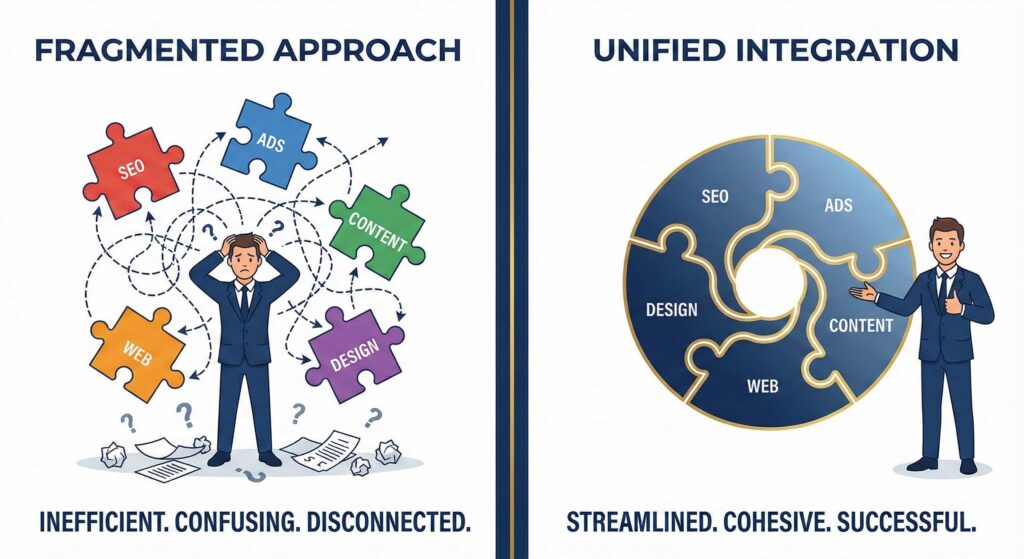
After 6+ years working with Dubai businesses who switched from fragmented agencies to integrated marketing, I’ve identified five consistent problems:
1. Zero Strategic Alignment
Your SEO team optimizes for keywords without considering what your paid ads target. Your content writer creates blog posts that don’t support your sales funnel. Your web designer builds beautiful pages that don’t convert. Everyone works in isolation, optimizing for different goals.
In an integrated marketing approach, all channels support each other. SEO content feeds into paid campaigns. Landing pages align with ad messaging. Email sequences reinforce social media content. Everything works together toward your actual business objectives.
2. Inconsistent Brand Messaging
Different agencies create different tones, different value propositions, different calls-to-action. Your brand voice changes from channel to channel. This confusion erodes trust faster than anything else in Dubai’s competitive market.
I’ve audited marketing for Dubai healthcare companies where the website promised “affordable medical licensing,” the Facebook ads emphasized “premium services,” and the email campaigns focused on “fast processing.” Three different messages from three different agencies. Potential clients had no idea what the company actually offered.
3. Data Fragmentation
Research shows that fragmented tools create inefficiencies and increase chances of data inconsistencies. When your analytics sit in Google Analytics, your ad data lives in Meta Business Suite, your SEO metrics exist in Ahrefs, and your CRM tracks leads separately, you can’t measure true ROI.
Full-stack marketing consolidates everything into unified dashboards. You see exactly which channels drive qualified leads, which campaigns deliver the lowest cost-per-acquisition, and where to allocate budget for maximum return.
4. Slow Execution
Want to change your campaign strategy? With multiple agencies, you brief each one separately, wait for their individual responses, coordinate timeline across all of them, and hope they execute consistently. Simple changes take weeks.
With integrated marketing, strategy shifts happen immediately. I manage AED 45,000+ in monthly advertising budgets for Dubai clients. When market conditions change or new opportunities emerge, we pivot within hours—not weeks.
5. Accountability Gaps
When results underperform, everyone points fingers. The SEO agency blames the website. The ads manager blames the landing pages. The content team blames the targeting. Nobody owns the outcome.
Full-stack marketing provides single-point accountability. If traffic doesn’t convert, if leads don’t qualify, if ROI disappoints—I own it. There’s nowhere to hide and no excuses to make.
Full-Stack Digital Marketing: One Integrated System, Zero Coordination Overhead
So what is full-stack digital marketing actually?
It’s not just one person who knows a little bit about everything. That’s a generalist, and generalists deliver generic results. Full-stack marketing means deep expertise in 1-2 specific areas combined with strong working knowledge across all marketing disciplines.
T-shaped marketers, as this profile is called, can execute comprehensive strategies independently while understanding how every marketing element interconnects. The vertical bar of the T represents specialized expertise. The horizontal bar represents broad knowledge across multiple channels.
Core Components of Full-Stack Marketing
When I work with Dubai businesses, I integrate six critical marketing components into one cohesive system:
SEO (Technical, On-Page, Local, Content)
This isn’t just “ranking on Google.” Modern SEO in 2025 requires technical optimization like Core Web Vitals (LCP, FID, CLS metrics), Schema markup for entity-based search, Knowledge Graph optimization, and mobile-first indexing. For Dubai businesses, local SEO demands Google Business Profile optimization, NAP consistency across citations, and area-specific targeting for Business Bay, DIFC, Dubai Marina, and other key locations.
Content Marketing (Strategy, Writing, Distribution)
Content serves multiple purposes simultaneously. Blog posts target long-tail keywords for organic traffic. Landing pages convert paid advertising visitors. Email sequences nurture leads through the sales funnel. Social media content builds brand awareness. In fragmented marketing, these exist separately. In full-stack marketing, they reinforce each other.
Web Design & Development (WordPress, Landing Pages, CRO)
Your website isn’t a brochure—it’s a conversion machine. Every page needs strategic purpose. Homepage establishes credibility and guides visitors to next steps. Service pages address specific search intent. Landing pages convert ad traffic with focused messaging. Contact forms capture lead information efficiently. Technical implementation matters as much as design.
Paid Advertising (Google Ads, Meta Ads, LinkedIn)
Strategic paid advertising accelerates results while organic efforts build momentum. Google Ads captures high-intent searchers actively looking for your services. Meta Ads creates brand awareness and retargets engaged audiences. LinkedIn Ads reaches B2B decision-makers in Dubai’s business districts. Budget allocation, audience targeting, and creative testing require constant optimization.
Conversion Rate Optimization (Testing, Analytics, Funnels)
According to CRO statistics, conversion rate optimization tools deliver a median ROI of 223%. Every 1% improvement in conversion rate dramatically impacts revenue without increasing traffic costs. A/B testing headlines, optimizing form fields, improving page speed, and analyzing user behavior through heatmaps all contribute to higher conversion rates.
Design & Video (Canva Pro, AI Tools, CapCut)
Visual content performs. Research shows that 75% of marketers report better ROI when adding visuals to content. Social media posts with images drive 3x engagement. Landing pages with video can increase conversion rates by 80%. Professional design doesn’t require expensive agencies when you understand tools and principles.
The T-Shaped Marketer Advantage
Here’s what separates full-stack marketers from both specialists and generalists.
Specialists (I-shaped marketers) excel in one area but can’t see the bigger picture. An SEO specialist optimizes for rankings without considering whether that traffic converts. A paid ads specialist drives clicks without evaluating landing page quality. They deliver narrow wins that don’t impact business outcomes.
Generalists understand multiple areas superficially but lack depth to execute effectively. They know SEO exists and ads cost money, but they can’t actually optimize technical elements or reduce cost-per-click through advanced bidding strategies.
T-shaped marketers combine specialist-level expertise in core areas with sufficient knowledge across all channels to create integrated strategies. I specialize in technical SEO and conversion-focused paid advertising. I also execute content strategy, build WordPress sites, design graphics, and analyze marketing funnels. Everything works together because I understand how the pieces interconnect.
This versatility matters especially in Dubai’s market. A healthcare client needs DHA compliance expertise. A real estate client requires RERA regulation knowledge. An e-commerce business demands Google Shopping proficiency. Full-stack marketing adapts to industry-specific requirements while maintaining strategic coherence.
How One Full-Stack Marketer Delivered What 5 Agencies Couldn’t
Let me show you exactly what integrated marketing accomplishes with three real Dubai case studies from my 6+ years of experience.
Case Study #1: Dubai Real Estate – 50 to 44,800 Monthly Visits
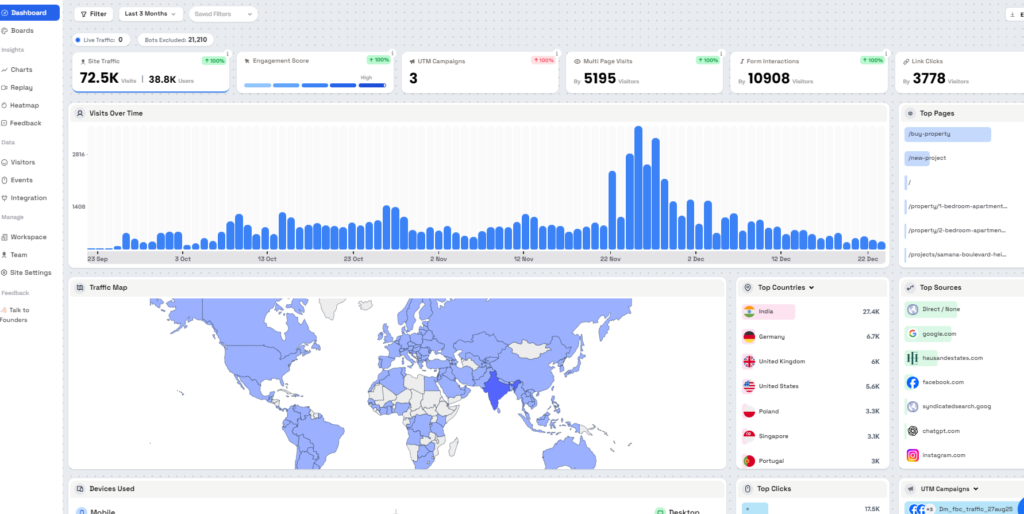
Client: Haus & Estates Properties, a Dubai-based real estate agency specializing in off-plan properties.
Challenge: The agency had minimal online presence with only 50 monthly website visits. They competed against established agencies with larger marketing budgets and stronger brand recognition. Previous attempts with separate SEO and advertising agencies produced inconsistent results because strategies weren’t aligned.
Integrated Strategy I Implemented:
Technical SEO foundation came first. I optimized Core Web Vitals to achieve scores above 90 for Largest Contentful Paint, First Input Delay, and Cumulative Layout Shift. Mobile optimization was critical since most Dubai property searches happen on phones. Schema markup for real estate listings helped Google understand property data for Knowledge Graph inclusion.
Local SEO optimization targeted Dubai-specific searches. I optimized their Google Business Profile with property photos, business hours, and service area coverage across Business Bay, Dubai Marina, and Downtown Dubai. Local citations ensured NAP consistency across Dubai directories and real estate portals.
Content strategy targeted property investment keywords with high commercial intent. I created conversion-optimized landing pages for specific developments like DAMAC Islands and Emaar projects. Each page addressed investor concerns, showcased property features, and included clear calls-to-action for consultations.
Strategic paid advertising amplified organic efforts. Google Ads campaigns targeted high-intent keywords like “off-plan properties Dubai investment” and “Dubai property for sale Business Bay.” Meta Ads built brand awareness and retargeted website visitors who didn’t convert initially. Budget allocation across platforms ensured maximum reach at optimal cost.
Results Achieved:
Traffic grew from 50 to 44,800 monthly visits in 6 months—a combination of organic growth and paid traffic working together. This wasn’t vanity metrics. Qualified property inquiries increased 3x. More importantly, advertising cost-per-lead decreased by 40% through continuous optimization of targeting, creative, and landing pages.
Why It Worked:
Everything coordinated from day one. SEO content informed ad targeting. Landing pages matched ad messaging exactly. Google Ads data revealed which keywords converted best, guiding SEO priorities. Meta Ads retargeted people who engaged with blog content. The integrated approach delivered compound effects that separate agencies never achieve.
Case Study #2: Healthcare Recruitment – 180% Lead Increase
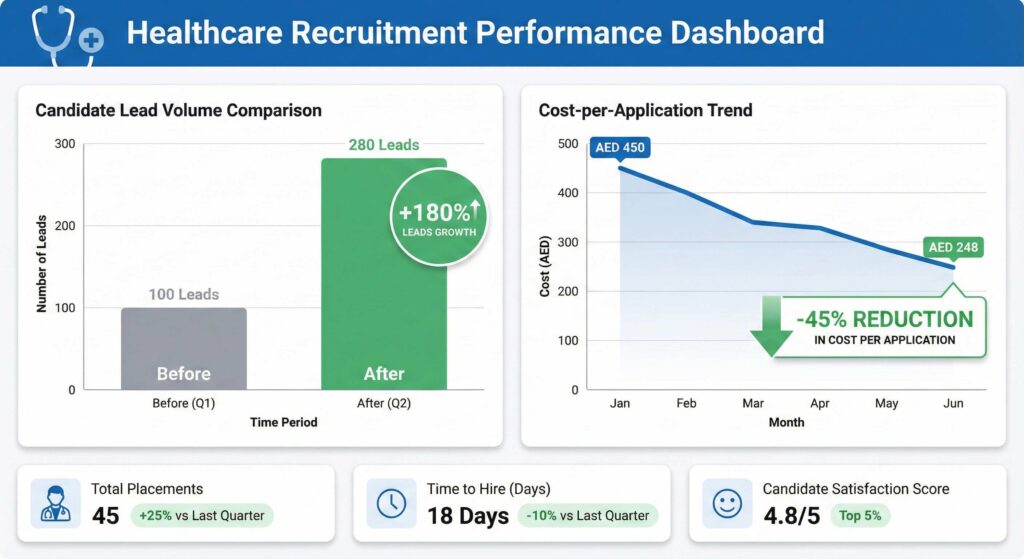
Client: First Medical Consultancy, a Dubai-based medical licensing and recruitment agency helping healthcare professionals obtain GCC licenses.
Challenge: The agency needed more qualified leads from healthcare professionals seeking licenses in Dubai, Abu Dhabi, and across the GCC region. Previous marketing efforts were expensive and inconsistent. Multiple vendors (LinkedIn ads, Google Ads, content writer) didn’t coordinate strategies, resulting in confused messaging and high cost-per-application.
Integrated Strategy I Implemented:
LinkedIn marketing targeted healthcare professionals specifically. Advanced targeting reached doctors, nurses, and medical specialists interested in GCC opportunities. Sponsored content showcased success stories and licensing timelines. InMail campaigns personalize outreach to qualified candidates.
Google Ads campaigns targeted medical licensing keywords with clear intent. Searches like “DHA license Dubai requirements” and “medical license UAE process” indicated serious interest. Ad copy emphasized fast processing, compliance expertise, and support throughout the licensing journey. Extensions displayed DHA approval credentials for credibility.
Meta Ads created brand awareness among healthcare professionals exploring GCC opportunities. Carousel ads showcased different license types (DHA, DOH, DHCC, MOH). Video testimonials from licensed professionals built trust. Retargeting kept the agency top-of-mind for people researching options.
Conversion-optimized landing pages addressed specific license types. Each page explained requirements, timelines, costs, and success rates. DHA compliance was emphasized throughout since healthcare advertising in Dubai requires strict adherence to regulations. Lead capture forms were optimized to reduce friction while gathering qualification information.
Email nurture sequences qualified leads automatically. New applicants received educational content about licensing processes. Follow-up sequences addressed common concerns and objections. Automated reminders kept engaged prospects moving through the application funnel.
Results Achieved:
Qualified medical professionals leads increased 180% in 4 months. Cost-per-application decreased by 45% through better targeting and landing page optimization. The agency generated 500+ qualified healthcare professional leads during the campaign period. Most importantly, 12 critical positions were filled in 3 months—the actual business outcome that mattered.
Why It Worked:
The unified strategy ensured consistent messaging across all channels. LinkedIn targeted the right audience. Google Ads captured active searchers. Meta Ads built awareness. Landing pages converted traffic efficiently. Email sequences nurtured leads systematically. DHA compliance was maintained throughout every touchpoint. Everything reinforced everything else.
Case Study #3: E-Commerce Furniture – 85% Sales Increase
Client: Fams Furniture, a Dubai e-commerce store selling furniture and home goods online.
Challenge: As a new e-commerce business, Fams Furniture struggled to generate sales in Dubai’s competitive furniture market. Limited brand awareness meant customer acquisition costs were high. Cart abandonment rate exceeded 70%. Previous attempts with separate agencies for Google Shopping and Facebook ads produced inconsistent returns.
Integrated Strategy I Implemented:
Google Shopping campaigns showcased products directly in search results. I optimized product feeds with high-quality images, detailed descriptions, competitive pricing, and accurate attributes. Shopping ads appeared when Dubai consumers searched for specific furniture items. Dynamic remarketing showed abandoned cart items to visitors who didn’t complete purchases.
Meta Ads catalog campaigns displayed furniture visually across Facebook and Instagram. Carousel ads highlighted room collections. Dynamic product ads retargeted people who viewed specific items. Video ads showed furniture in styled Dubai homes, creating emotional connection and demonstrating quality.
Conversion rate optimization improved the purchase funnel systematically. Product pages were redesigned with better images, clearer descriptions, trust signals, and prominent add-to-cart buttons. Checkout process was streamlined to reduce friction. Exit-intent popups captured emails from abandoning visitors.
Retargeting campaigns across both platforms kept Fams Furniture visible to interested shoppers. People who added items to cart received reminder ads. Visitors who browsed categories saw relevant product recommendations. Email campaigns complemented paid retargeting with special offers.
Mobile optimization was critical since most furniture browsing in Dubai happens on phones. Page speed improvements reduced load times. Mobile checkout was simplified. Click-to-WhatsApp integration let customers ask questions instantly.
Results Achieved:
Sales increased 85% in the first quarter. Cart abandonment rate decreased by 35% through conversion optimization. Average order value improved as product recommendations drove upsells. Customer acquisition cost became profitable as integrated campaigns compounded effectiveness.
Why It Worked:
Google Shopping captured high-intent buyers searching for specific furniture. Meta Ads built brand awareness and desire. Retargeting across both platforms maximized conversion opportunities. Conversion optimization ensured traffic didn’t waste. Mobile optimization matched how Dubai consumers actually shop. The integrated approach created a seamless journey from discovery to purchase.
How to Implement Full-Stack Digital Marketing in Dubai (4-Step Framework)
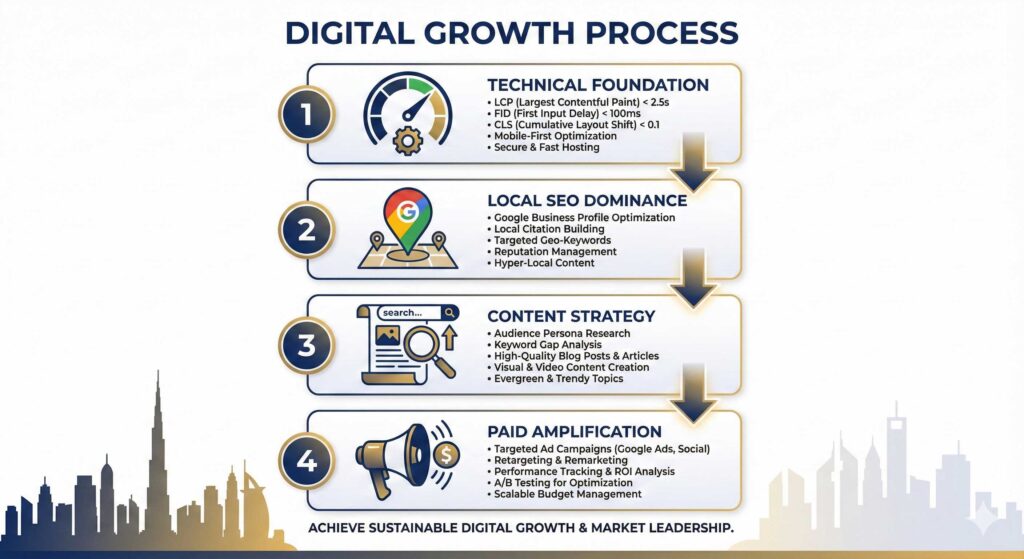
Based on 6+ years implementing integrated marketing for Dubai businesses, I’ve developed a systematic framework that delivers consistent results. Here’s exactly how I approach every client engagement.
Step 1: Auditing Your Technical Foundation (Core Web Vitals)
Everything starts with technical excellence. Your website is the foundation for all marketing efforts. If technical issues prevent Google from crawling pages, slow down load times, or create poor mobile experiences, no amount of advertising or content will deliver optimal results.
Website speed optimization focuses on Core Web Vitals, which Google uses to measure user experience quality. Largest Contentful Paint (LCP) measures how quickly the main content loads—target under 2.5 seconds. First Input Delay (FID) measures interactivity responsiveness—target under 100 milliseconds. Cumulative Layout Shift (CLS) measures visual stability—target under 0.1.
I optimize these metrics through image compression (converting to WebP format reduces file sizes by 30-50%), lazy loading (images below the fold don’t load until scrolling begins), minification of CSS and JavaScript (removing unnecessary code reduces file sizes), and content delivery network implementation (serving files from servers closest to Dubai visitors).
Mobile optimization is non-negotiable in the UAE market. According to UAE digital marketing research, the UAE has over 99% internet penetration—one of the highest rates globally. Most browsing happens on mobile devices. Responsive design ensures your site adapts to any screen size. Touch-friendly buttons prevent mis-clicks. Simplified navigation reduces friction on small screens.
Schema markup creates structured data that helps Google understand page content for Knowledge Graph inclusion. For real estate sites, I implement PropertyListing schema with property details, pricing, and locations. For healthcare sites, MedicalOrganization schema establishes credentials. For service businesses, LocalBusiness schema displays hours, contact information, and service areas in search results.
Indexation and crawl optimization ensures Google can discover and understand all important pages. XML sitemaps guide crawlers to priority content. Robots.txt prevents crawling of unimportant pages. Canonical tags eliminate duplicate content issues. Internal linking establishes page hierarchy and distributes authority.
Step 2: Building Your Local SEO Dominance
Dubai businesses compete locally first, internationally second. Local SEO establishes visibility where it matters most—when potential customers search for services in their area.
Google Business Profile optimization is the single highest-impact local SEO tactic. I ensure complete information accuracy (business name, address, phone matching exactly across all citations), category selection (primary and secondary categories capturing all service offerings), business description (highlighting Dubai expertise and unique value proposition), hours of operation (including special holiday hours), and service area coverage (specific Dubai neighborhoods served).
High-quality photos demonstrate professionalism. Interior shots showcase office environment. Exterior photos help customers find location. Service photos illustrate offerings. Team photos build personal connection. According to Google research, businesses with photos receive 42% more requests for directions and 35% more clicks to websites.
Customer reviews impact rankings and conversions simultaneously. I implement systematic review collection through email follow-ups, SMS requests, and in-person asks. Responding to all reviews (positive and negative) shows active management and customer care. Review velocity matters—consistent new reviews signal active business.
Local citations are mentions of your business name, address, and phone (NAP) across directories and websites. Consistency is critical. Variations like “Dubai, UAE” versus “Dubai, United Arab Emirates” confuse Google’s entity matching. I audit existing citations for accuracy and build new citations on relevant Dubai directories, industry-specific platforms, and local chambers of commerce.
Dubai-specific keyword targeting captures local search intent. Generic terms like “digital marketing” face global competition. Dubai-specific terms like “digital marketing Dubai,” “marketing services Business Bay,” and “advertising agency DIFC” target local searchers with commercial intent. Area-specific content addresses neighborhoods where target customers work and live.
RERA and DHA compliance for real estate and healthcare respectively ensures marketing doesn’t violate Dubai regulations. Real estate advertising requires specific disclaimers and approved language through RERA (Real Estate Regulatory Authority). Healthcare advertising follows DHA (Dubai Health Authority) guidelines on claims, testimonials, and promotional content. Non-compliance risks penalties and reputation damage.
Step 3: Creating Your Content Strategy
Content isn’t just blog posts. Strategic content serves multiple purposes—attracting organic traffic, educating prospects, supporting sales conversations, and establishing expertise.
Topical authority mapping replaces outdated keyword stuffing. Modern search engine algorithms understand topics and entities, not just keywords. I create comprehensive content covering all aspects of a subject area. For example, a real estate client doesn’t just target “Dubai property”—we cover property types, investment strategies, financing options, legal requirements, area guides, market trends, and developer profiles.
This hyponymic precision (defining specific concepts within broad categories) helps Google recognize expertise. When we write about Schema markup, Core Web Vitals, Knowledge Graph optimization, and entity-based SEO, Google understands we possess deep technical knowledge. That authority transfers to related search queries.
Entity-based content focuses on establishing clear Subject-Predicate-Object relationships that search engines understand. “Muhammad Zubair [subject] achieved [predicate] 44,800 monthly visits [object] for Haus & Estates Properties [subject] in 6 months [object].” These factual statements create entity associations that improve ranking for relevant queries.
Content must satisfy search intent completely. If someone searches “cost of SEO Dubai,” they want pricing information. A blog post that rambles about SEO benefits without addressing cost wastes their time. I ensure every piece of content answers the specific question behind the search query.
Dubai market expertise differentiates content from generic international articles. Anyone can write about “digital marketing strategies.” Only someone with local experience can explain how RERA regulations affect real estate advertising, why DHA compliance complicates healthcare marketing, or how cultural considerations in the GCC region impact social media strategy.
I demonstrate this expertise through specific examples (referencing Business Bay, Dubai Marina, DIFC), local regulations (DHA, RERA, Dubai Land Department requirements), regional data (UAE internet penetration, Dubai market size), and case studies from actual Dubai clients.
Integration with paid campaigns ensures content and advertising reinforce each other. Blog posts targeting informational keywords attract early-stage prospects who aren’t ready to buy. Remarketing ads bring them back when purchase intent increases. Landing pages optimized for transactional keywords capture Google Ads traffic. Email sequences nurture blog subscribers with case studies and offers.
Step 4: Paid Amplification Strategy
Paid advertising accelerates results while organic efforts build momentum. Strategic budget allocation across platforms maximizes reach and conversions at optimal cost.
Google Ads for high-intent keywords captures people actively searching for your services. Someone searching “medical license Dubai application” has clear commercial intent. Search ads appear at the exact moment they’re looking for help. Ad copy emphasizes unique value (faster processing, higher success rate, compliance expertise). Extensions display credentials (DHA approved, 500+ licenses processed) that build immediate trust.
Campaign structure matters. Separate campaigns for different service lines enable budget control. Ad groups organized by keyword theme improve Quality Score through relevance. Responsive search ads test multiple headlines and descriptions automatically. Call extensions enable direct contact for mobile searchers.
Bidding strategy balances cost and volume. Manual CPC provides control during testing. Maximize Conversions shifts to automation after sufficient conversion data accumulates. Target CPA (cost-per-acquisition) focuses on efficiency once conversion volume stabilizes.
Meta Ads for brand awareness reaches people before they actively search. Detailed targeting finds audiences by demographics, interests, and behaviors. Lookalike audiences based on existing customers discover similar prospects. Retargeting keeps your business visible to website visitors who didn’t convert initially.
Creative testing identifies what resonates. Carousel ads showcase multiple products or services. Video ads tell brand stories and explain complex services. Image ads highlight specific offers. Meta’s algorithm optimizes delivery toward best-performing creative automatically.
Campaign objectives align with funnel position. Awareness campaigns use reach objective to maximize impression volume. Consideration campaigns use traffic or engagement objectives to drive website visits or social engagement. Conversion campaigns use conversion objective to optimize for purchases, leads, or applications.
Budget allocation across platforms depends on business model and audience behavior. B2B services often perform better on LinkedIn despite higher costs because professional targeting is precise. E-commerce typically favors Meta Ads for visual product display. Local services benefit from Google Local Services Ads for immediate visibility.
I manage AED 45,000+ in monthly advertising budgets for Dubai clients. At this scale, strategic allocation becomes critical. Wasting even 10% means AED 4,500 monthly disappearing with no return. I monitor performance daily, shift budget toward top performers, pause underperforming campaigns quickly, and test new opportunities systematically.
How paid and organic work together creates compound effects. Paid ads generate immediate traffic while SEO builds. Organic content attracts early-stage prospects who aren’t ready to convert. Remarketing ads bring them back when intent increases. Search ads capture branded searches created by brand awareness campaigns. Everything reinforces everything else for maximum total impact.
Dubai Agency Costs vs Full-Stack Marketing (60% Savings Breakdown)
Let’s examine the actual costs of comprehensive digital marketing in Dubai’s competitive market and how integrated full-stack marketing delivers equivalent or superior results at significantly lower investment.
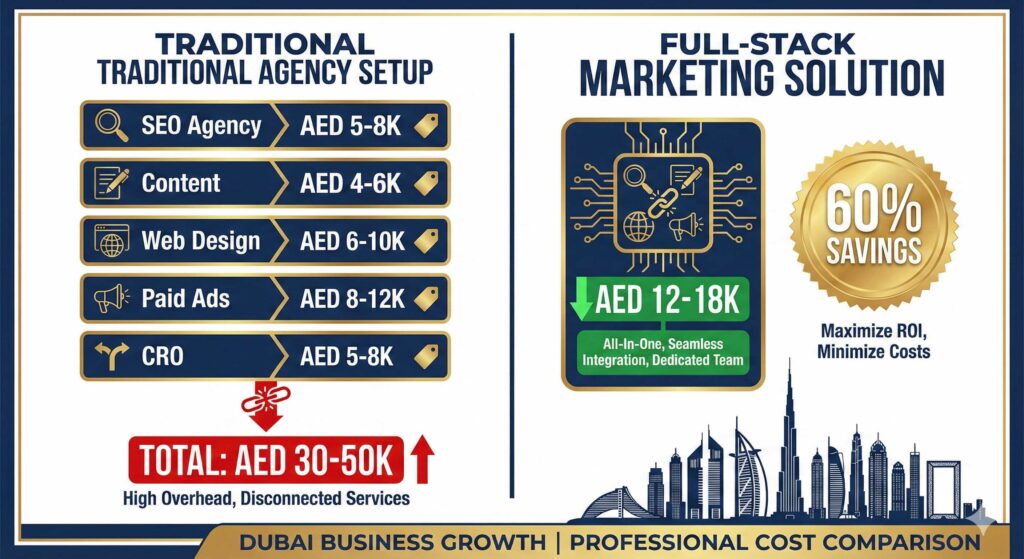
Traditional Agency Setup (AED 30,000-50,000/month)
Based on current Dubai agency pricing research and UAE digital marketing cost analysis, here’s what businesses typically pay for comprehensive services:
SEO Agency: AED 5,000-8,000 per month covers technical audits, on-page optimization, content strategy, link building, and monthly reporting. Premium agencies in Dubai charge toward the higher end while smaller firms offer basic packages at lower rates.
Content Marketing Agency: AED 4,000-6,000 per month includes blog post writing (typically 4-8 posts monthly), social media content creation, email copywriting, and basic graphic design. High-quality content from experienced writers commands premium pricing.
Web Design and Development: AED 6,000-10,000 per month covers landing page creation, website updates, technical fixes, and conversion optimization testing. Ongoing development retainers ensure consistent support but at substantial monthly cost.
Paid Advertising Manager: AED 8,000-12,000 per month manages Google Ads and Meta Ads campaigns. This typically represents 15-20% of ad spend as management fee, with AED 4,000 minimum monthly retainer for hands-on optimization.
CRO Specialist: AED 5,000-8,000 per month provides conversion rate optimization through A/B testing, analytics analysis, heatmap reviews, and funnel optimization recommendations.
Total monthly investment: AED 28,000-44,000 just for the base services.
But the real cost extends beyond vendor fees. The “coordination tax” includes:
Your time managing vendors: 10-15 hours monthly briefing agencies, attending status meetings, reviewing reports, and coordinating between teams. If your time is worth AED 500/hour (conservative for business owner or marketing director), that’s AED 5,000-7,500 monthly in opportunity cost.
Tools and software subscriptions: Each agency uses different platforms. You pay for redundant analytics tools, separate reporting systems, multiple communication platforms. This easily adds AED 2,000-3,000 monthly.
Delayed execution costs: Multi-agency coordination slows decision-making and campaign launches. Opportunities missed due to slow execution cost real money. A competitor who moves faster captures market share you could have owned.
Inconsistent performance: When agencies don’t align, results suffer. Your SEO content doesn’t support paid campaigns. Landing pages don’t match ad messaging. Brand voice varies across channels. Suboptimal performance costs more than any individual service fee.
True total cost: AED 35,000-55,000 monthly when you account for all direct and indirect expenses.
Full-Stack Marketing System (AED 12,000-18,000/month)
Integrated full-stack marketing delivers all services through one strategic system at dramatically lower cost:
All services integrated: SEO, content marketing, web development, paid advertising, conversion optimization, and graphic design work together under unified strategy. No coordination overhead. No conflicting priorities. No vendor management headaches.
Zero coordination tax: Brief once, execute consistently. Strategy changes implement immediately. Questions get answered in minutes, not days. All data flows into unified dashboards showing complete marketing performance.
Faster execution: New campaigns launch same week. Landing page changes happen same day. Budget shifts occur in real-time based on performance data. Speed creates competitive advantage.
Single point of accountability: If traffic doesn’t convert, if leads don’t qualify, if ROI disappoints—one person owns the outcome. No finger-pointing. No excuses. Complete responsibility drives better results.
60% cost savings demonstrated: The AED 12,000-18,000 monthly investment delivers equivalent or superior results to AED 35,000-55,000 multi-agency setup. This isn’t theoretical—it’s proven across multiple Dubai businesses in my 6+ years of experience.
The savings come from efficiency (no redundant work across agencies), expertise (deep knowledge across all channels versus surface-level generalists), alignment (every channel supports others), and accountability (ownership drives optimization).
7 Critical Mistakes Dubai Businesses Make with Digital Marketing

After 6+ years helping Dubai businesses fix broken marketing, I’ve identified recurring mistakes that waste money and limit results. Here’s what to avoid.
1. Hiring Specialists Instead of T-Shaped Marketers
Specialists optimize for their narrow domain without considering broader business impact. The SEO expert focuses on rankings regardless of conversion rates. The paid ads manager cares about click-through rate regardless of lead quality. The content writer produces articles without considering sales funnel position.
Research on T-shaped marketers shows these versatile professionals understand how different marketing elements interconnect. They optimize for business outcomes, not channel-specific vanity metrics. They collaborate effectively because they understand each specialist’s perspective while maintaining strategic vision.
2. Treating SEO and Paid Ads as Separate Strategies
According to HubSpot’s State of Marketing Report 2025, the top marketing channels driving ROI for B2B brands are websites/blogs/SEO efforts combined with paid social media content. The operative word is “combined”—not separate.
SEO content attracts early-stage prospects researching solutions. Paid ads retarget those visitors when purchase intent increases. Search ads capture branded searches created by awareness campaigns. Organic rankings reduce paid advertising costs for commercial keywords. Everything works better together.
3. Ignoring Dubai-Specific Compliance (DHA, RERA)
Healthcare marketing in Dubai requires strict adherence to DHA regulations. Medical claims require evidence. Testimonials need disclaimers. Promotional content follows specific guidelines. Non-compliance risks, penalties, forced content removal, and reputation damage.
Real estate advertising through RERA mandates approved language and specific disclosures. Off-plan property marketing requires developer authorization. Investment claims need substantiation. Understanding these regulations isn’t optional—it’s mandatory for operating legally in Dubai’s market.
4. Measuring Vanity Metrics Instead of Business Outcomes
Impressions don’t pay bills. Likes don’t generate revenue. Traffic without conversions is worthless. According to marketing ROI research, marketers who calculate ROI are 1.6x more likely to receive higher budgets because they demonstrate tangible business impact.
Focus on metrics that matter: qualified leads generated, cost-per-acquisition achieved, conversion rates throughout funnel, customer lifetime value, and actual revenue attributed to marketing efforts.
5. Copying International Strategies Without Dubai Adaptation
What works in New York doesn’t work in Business Bay. Cultural considerations affect messaging in the GCC region. Search behavior differs between Dubai and Western markets. Business relationship building follows different patterns. Ramadan and Eid require strategy adjustments.
After 6+ years working exclusively in Dubai, I understand these nuances. International marketing agencies applying generic Western strategies miss critical local factors that determine success or failure.
6. Neglecting Mobile Optimization
The UAE has 99% internet penetration according to market research. Most browsing happens on mobile devices. Yet I still audit Dubai websites with slow mobile load times, non-responsive designs, and difficult mobile checkout processes.
Mobile-first is non-negotiable in 2025. Google indexes mobile versions first. Users abandon slow-loading pages. Conversions suffer from poor mobile experiences. Every website element must work flawlessly on smartphones.
7. Not Tracking ROI Across All Channels
Industry data shows that 47% of marketers struggle to measure ROI across multiple channels because data sits in silos. Without attribution modeling that tracks customer journey across touchpoints, you can’t optimize budget allocation effectively.
Integrated tracking with full-stack approach connects all marketing activities to business outcomes. Google Analytics 4 tracks cross-platform behavior. UTM parameters identify traffic sources. Conversion tracking measures specific actions. CRM integration attributes revenue to marketing channels.
Essential Tools for Full-Stack Digital Marketing
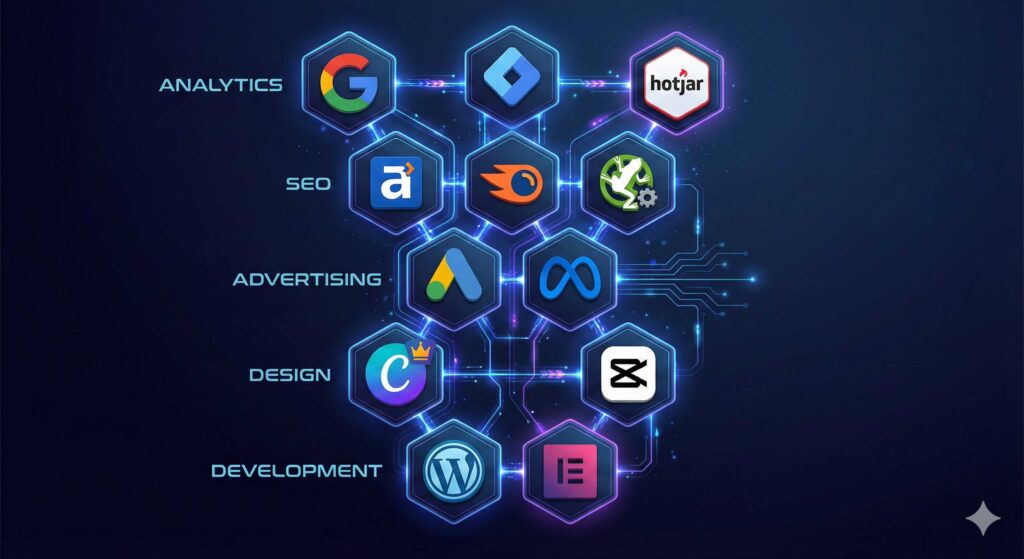
Strategic tool selection enables one marketer to accomplish what traditionally required entire teams. Here’s the technology stack I use for Dubai clients:
Analytics & Tracking: Google Analytics 4 provides cross-platform user journey tracking. Google Tag Manager simplifies tracking implementation without developer dependency. Hotjar reveals actual user behavior through heatmaps, session recordings, and scroll depth analysis.
SEO Tools: Ahrefs discovers keyword opportunities, analyzes competitors, and monitors backlink profiles. SEMrush provides technical audits, rank tracking, and content optimization recommendations. Screaming Frog crawls websites to identify technical issues like broken links, duplicate content, and missing metadata.
Paid Advertising: Google Ads manager provides campaign creation, optimization, and reporting for search, shopping, and display ads. Meta Business Suite manages Facebook and Instagram advertising with detailed audience targeting and automated optimization.
Design & Creative: Canva Pro enables professional graphic design without traditional design software learning curve. CapCut creates engaging video content for social media. AI image generators (DALL-E, Midjourney) produce custom visuals for specific campaign needs.
Development: WordPress provides flexible website management. Elementor creates landing pages through visual drag-and-drop interface. WP Rocket optimizes site speed through caching and performance enhancements.
Automation: Zapier connects different platforms to automate repetitive tasks. Email marketing platforms (like Mailchimp or ActiveCampaign) nurture leads through automated sequences.
Full-stack marketers leverage these tools efficiently because they understand how each contributes to broader strategy. Specialists often know one tool deeply but struggle to connect insights across platforms.
When to Expect Results from Full-Stack Digital Marketing
Let’s establish realistic expectations. Digital marketing isn’t magic—it’s systematic strategy execution over time. Based on 6+ years of Dubai experience, here’s what typically happens:
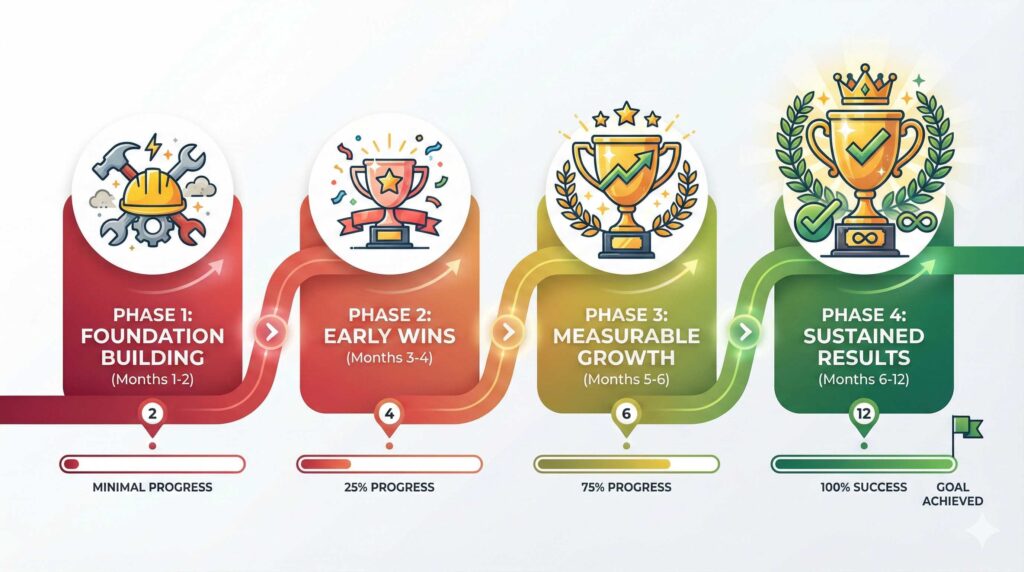
Months 1-2: Foundation Building
The first 60 days focus on establishing technical excellence and launching initial campaigns.
Technical SEO fixes implement during weeks 1-2. Core Web Vitals optimization improves page speed, mobile responsiveness, and visual stability. Schema markup creates structured data for Knowledge Graph inclusion. Indexation issues get resolved.
Initial campaigns launch during weeks 3-4. Google Ads campaigns target high-intent keywords with conversion-optimized landing pages. Meta Ads campaigns begin building brand awareness and testing creative variations. Content creation focuses on cornerstone pieces that establish topical authority.
Tracking systems implement comprehensively. Google Analytics 4 captures cross-platform behavior. Conversion tracking measures specific actions. UTM parameters attribute traffic to proper sources. Dashboard creation consolidates data for easy monitoring.
Expect minimal results during this phase. You’re building foundation for future growth, not generating immediate ROI. Patience here pays dividends later.
Months 3-4: Early Wins
Momentum builds as optimization cycles complete and compound effects begin.
Traffic starts increasing as technical improvements impact rankings and paid campaigns optimize through testing. Content begins ranking for long-tail keywords. Local SEO efforts improve Google Business Profile visibility.
Paid campaigns optimize through continuous testing of targeting, creative, landing pages, and bidding strategies. Cost-per-click decreases. Conversion rates improve. Quality Score increases reduce costs further.
First conversion improvements materialize from CRO efforts. A/B testing identifies winning variations. User behavior analysis reveals friction points. Form optimization reduces abandonment.
Months 5-6: Measurable Growth
Significant impact becomes visible as all efforts compound.
Traffic increases substantially—like the 44,800 monthly visits achieved for Haus & Estates Properties. Organic rankings strengthen for commercial keywords. Paid advertising reaches optimal efficiency.
Lead quality improves through better targeting and messaging refinement. Qualification rates increase as campaigns attract more relevant prospects. Sales conversations convert at higher rates.
Cost-per-acquisition drops dramatically through systematic optimization. The 40% reduction achieved for real estate clients and 45% reduction for healthcare clients demonstrates realistic targets.
Months 6-12: Sustained Results
Long-term benefits materialize as full-stack strategy matures.
Compound effects kick in. Content library attracts consistent organic traffic. Brand awareness from paid campaigns reduces acquisition costs. Email list grows and generates revenue through nurture sequences.
Organic rankings strengthen further. Topical authority establishes your site as go-to resource in your industry. Backlinks accumulate naturally as content quality attracts references.
Predictable lead generation becomes reality. You know how many leads to expect monthly. You understand cost-per-acquisition across channels. Budget allocation optimizes based on proven performance.
Frequently Asked Questions
What is full-stack digital marketing and why does it matter for Dubai businesses?
Full-stack digital marketing integrates all marketing disciplines—SEO, content, web development, paid advertising, and conversion optimization—into one cohesive system executed by a T-shaped marketer with deep expertise in core areas and broad knowledge across all channels.
This matters for Dubai businesses because traditional multi-agency setups create fragmentation that wastes money and limits results. When your SEO team doesn’t communicate with your ads manager, when your content writer produces material unaligned with landing pages, when your web designer builds without understanding conversion principles—you pay coordination overhead while suffering inconsistent performance.
Dubai’s competitive market demands efficiency. With hundreds of real estate agencies competing for attention, with healthcare companies navigating strict DHA regulations, with e-commerce businesses fighting for customer acquisition, integrated marketing provides the strategic coherence necessary to win.
Full-stack marketing eliminates coordination tax. You brief once, execute consistently, measure comprehensively, and optimize systematically. Everything works together from day one. The 60% cost savings and superior results I’ve delivered across real estate, healthcare, and e-commerce clients demonstrate real-world effectiveness.
How much does full-stack digital marketing typically cost in Dubai?
Based on my 6+ years working with Dubai businesses, full-stack digital marketing typically costs AED 12,000-18,000 monthly for comprehensive integrated services including SEO, content marketing, web development, paid advertising management, conversion optimization, and graphic design.
This contrasts sharply with traditional multi-agency setups costing AED 30,000-50,000+ monthly. When you hire separate agencies for each service (SEO at AED 5,000-8,000, content at AED 4,000-6,000, web development at AED 6,000-10,000, paid ads at AED 8,000-12,000, CRO at AED 5,000-8,000), costs escalate quickly before accounting for coordination overhead and inefficiency.
The cost difference isn’t about cutting corners—it’s about efficiency. Integrated strategy eliminates redundant work. Deep cross-channel expertise enables one person to accomplish what requires multiple specialists when fragmented. Unified execution removes coordination delays. Single accountability drives optimization.
Return on investment matters more than absolute cost. If full-stack marketing costs AED 15,000 monthly but generates AED 100,000 in new business, that’s exceptional ROI. If multi-agency setup costs AED 40,000 monthly but delivers inconsistent results, that’s money wasted regardless of service breadth.
Budget should align with business size and revenue potential. A startup might begin at AED 8,000-12,000 monthly. An established business with AED 500,000+ monthly revenue should invest AED 15,000-25,000 for comprehensive coverage. Enterprise businesses with multiple service lines often invest AED 30,000+ across full-stack teams.
What are the main benefits of full-stack digital marketing for UAE companies?
The primary benefits I’ve observed across 6+ years working with UAE companies include cost savings, strategic coherence, execution speed, accountability, and market-specific expertise.
Cost savings of 60% compared to traditional agency setups come from operational efficiency. No redundant work across agencies. No coordination overhead. Unified strategy execution. Direct communication eliminating intermediary delays. These efficiencies translate to lower investment for equivalent or superior results.
Unified strategy where every channel supports others creates compound effects impossible with fragmentation. SEO content feeds paid campaigns. Landing pages align with ad messaging. Email sequences reinforce social media. Brand voice stays consistent across touchpoints. Everything works together toward actual business objectives.
Faster execution provides competitive advantage in Dubai’s fast-moving market. Strategy changes implement immediately. New campaigns launch within days. Budget shifts occur in real-time. Opportunities captured before competitors react. Speed multiplies effectiveness.
Better ROI through integrated optimization emerges when all channels optimize together rather than in isolation. According to HubSpot research, businesses that integrate multiple channels significantly outperform those that don’t. The 44,800 traffic growth for Haus & Estates, 180% lead increase for First Medical, and 85% sales growth for Fams Furniture demonstrate real outcomes.
Dubai expertise that international agencies can’t match comes from years working exclusively in this market. Understanding RERA regulations for real estate, DHA compliance for healthcare, cultural considerations in GCC marketing, local search behavior patterns, and Dubai business relationship dynamics—these factors determine success or failure.
How long does it take to see results from full-stack digital marketing?
Based on systematic implementation across multiple Dubai clients, realistic timelines follow a predictable pattern:
Months 1-2 focus on foundation building with technical SEO fixes, initial campaign launches, and tracking system implementation. Expect minimal immediate results during this phase. You’re establishing infrastructure for future growth. Technical improvements take time to impact rankings. Paid campaigns require testing data before optimization. Content needs to accumulate before topical authority establishes.
Months 3-4 bring early wins as optimization cycles complete. Traffic begins increasing from technical improvements and paid campaign optimization. Conversion rates improve from landing page testing. Cost-per-click decreases through Quality Score gains. Lead volume starts growing.
Months 5-6 deliver measurable growth as compound effects materialize. Significant traffic increases like the 44,800 monthly visits achieved for real estate clients become reality. Lead quality improves. Cost-per-acquisition drops substantially—40% reductions are achievable. ROI becomes clearly positive.
Months 6-12 establish sustained results as full-stack strategy matures. Organic rankings strengthen significantly. Topical authority generates consistent traffic. Email lists grow and convert. Predictable lead generation becomes reliable for business planning.
Timeline varies by industry competitiveness, starting position, and budget allocated. Highly competitive markets (Dubai real estate, luxury goods) take longer than niche services. Starting from zero takes longer than improving existing presence. Higher budgets accelerate results through increased reach.
The key is patience combined with systematic optimization. Quick fixes don’t exist. Sustainable growth requires consistent execution over months, not days. But the long-term results justify the investment—which is why businesses stick with full-stack marketing once they experience integrated effectiveness.
What are common mistakes businesses make with full-stack digital marketing?
The biggest mistakes I’ve observed include unrealistic expectations, wrong hire decisions, lack of tools investment, and insufficient strategic clarity.
Expecting overnight results dooms many initiatives. Digital marketing delivers compound growth over months, not explosive wins overnight. Businesses that abandon strategy after 60 days miss the substantial results that materialize in months 3-6. Patience paired with systematic optimization produces sustainable outcomes.
Hiring generalists instead of T-shaped marketers creates disappointing performance. A person who knows “a little bit about everything” can’t optimize Core Web Vitals, reduce cost-per-click through bidding strategies, or implement Schema markup. Full-stack marketing requires deep expertise in core areas combined with broad knowledge—not surface-level familiarity across the board.
Refusing to invest in necessary tools handicaps effectiveness. Quality SEO requires Ahrefs or SEMrush. Proper analytics needs Google Analytics 4 with conversion tracking. Design demands Canva Pro or similar platforms. Trying to execute without proper tools guarantees suboptimal results. Budget for AED 2,000-3,000 monthly in essential software.
Lacking clear business objectives prevents meaningful optimization. What constitutes success? More traffic? Lower cost-per-lead? Higher conversion rate? Increased revenue? Without defined goals and key performance indicators, you can’t determine whether marketing works or needs adjustment.
Ignoring Dubai market specifics by applying generic international strategies wastes money. RERA compliance, DHA regulations, cultural considerations, local search behavior, business relationship patterns—these factors require market-specific knowledge that international agencies don’t possess.
Micromanaging execution instead of focusing on strategy undermines the full-stack advantage. If you’re constantly questioning every tactical decision, you miss the point. Hire trusted expertise, define objectives clearly, review results regularly, but allow execution autonomy. Micromanagement destroys the speed advantage that makes full-stack marketing effective.
Stop Coordinating Multiple Agencies—Start Seeing Real Results
After 6+ years replacing fragmented agencies for Dubai businesses, the pattern is clear. Companies waste AED 30,000-50,000 monthly coordinating multiple vendors who don’t communicate, don’t align strategies, and don’t take accountability for business outcomes.
Full-stack digital marketing eliminates this expensive dysfunction through integrated strategy where every channel works together from day one. The results speak clearly: 50 to 44,800 monthly visits for real estate clients. 180% more qualified leads for healthcare businesses. 85% sales increases for e-commerce stores. All at 60% lower cost than traditional agency setups.
This isn’t theory. This is proven execution across multiple Dubai industries over thousands of hours managing campaigns, optimizing funnels, and delivering measurable ROI.
Dubai’s competitive market demands marketing that works—not coordination meetings that waste time. Your business deserves integrated strategy executed by someone who understands Core Web Vitals optimization, Google Ads bidding strategies, conversion rate testing, Schema markup implementation, and how everything interconnects to drive actual business results.
The question isn’t whether you need better marketing. You know you do. The question is whether you’re ready to stop managing multiple agencies and start seeing the results that come from full-stack integration.
Get your free marketing audit at muhammadzubair.me. I’ll analyze your current setup and show you exactly where you’re wasting money and how integrated full-stack marketing can deliver better results at lower cost.
Or call me directly: +971 50 136 1813. Let’s discuss your specific situation and whether full-stack marketing makes sense for your business.
After growing traffic from 50 to 44,800 monthly visits for Dubai real estate agencies, generating 180% more qualified leads for healthcare recruiters, and increasing e-commerce sales by 85% in first quarters—I can tell you with certainty: integrated marketing beats fragmented agencies every time.
The only question is when you’re ready to make the switch.