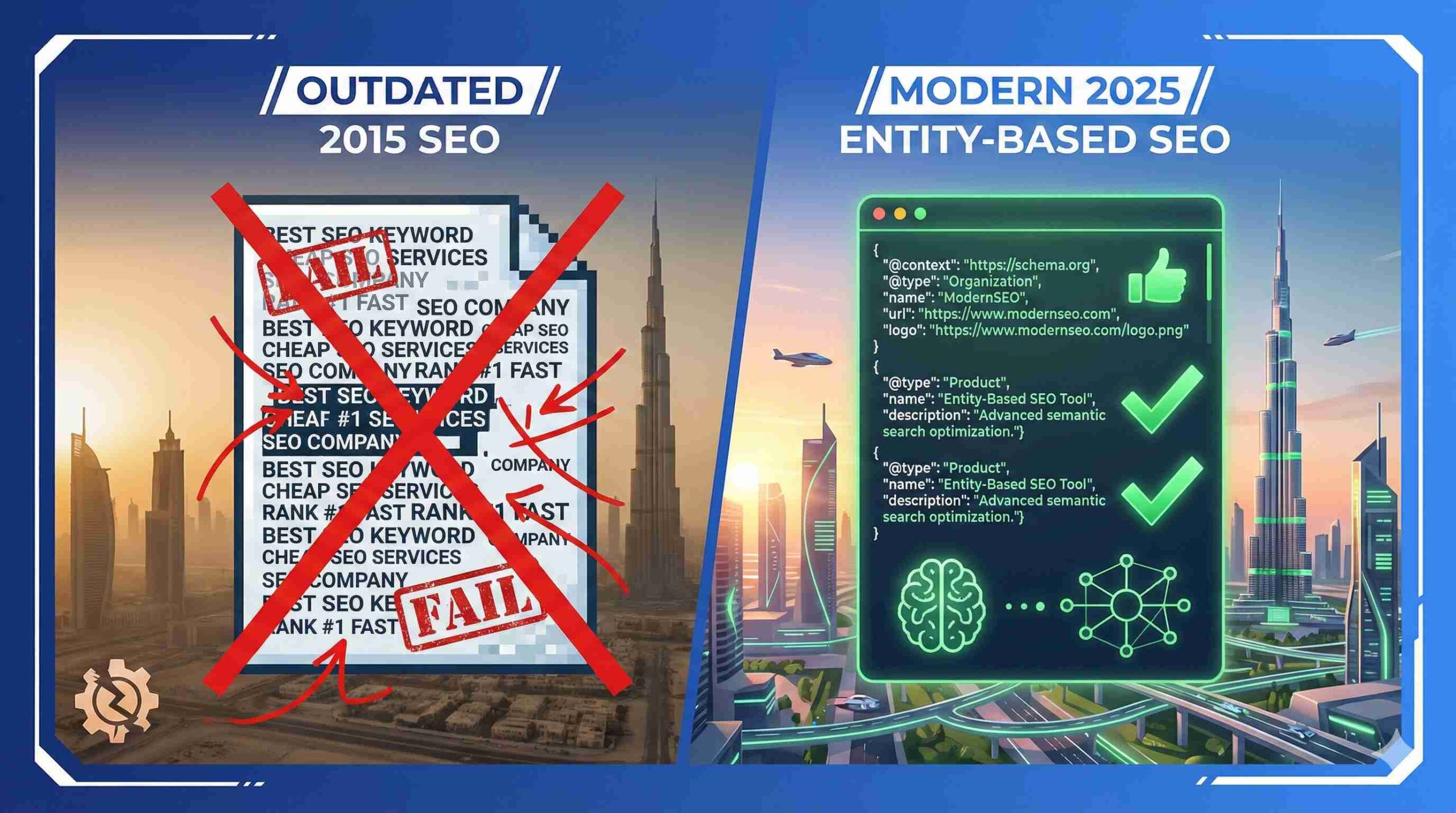

Most Dubai businesses spend AED 30,000+ monthly on SEO that doesn’t work. The problem isn’t your budget—it’s that you’re optimizing for 2015, not 2026.
I’ve watched dozens of Dubai companies waste money on keyword-stuffed content that Google’s algorithms ignore. They hire SEO agencies who repeat “Dubai property investment” 47 times per page and wonder why rankings never improve. Meanwhile, their competitors who understand entity-based optimization dominate search results with a fraction of the investment.
When I transitioned a Dubai real estate client from keyword-focused tactics to entity-based SEO in 2024, traffic grew from 50 to 44,800 monthly visits in 6 months. For a healthcare recruitment agency, implementing proper Schema markup and Knowledge Graph optimization generated 180% more qualified leads in 4 months while reducing cost-per-application by 45%.
The difference wasn’t magic. It was understanding what Google’s 2026 algorithms actually evaluate—entities, not keywords.
In this guide, I’ll show you exactly why traditional SEO fails in Dubai’s competitive market and how entity-based optimization creates the context Google needs. You’ll learn Core Web Vitals benchmarks that determine rankings, Schema markup implementation that establishes entity authority, and AI search optimization (GEO) strategies that get your business cited by ChatGPT, Perplexity, and Google’s AI Overviews.
Whether you’re a Dubai business owner frustrated with expensive SEO that delivers nothing or a marketing director looking to improve ROI, this guide will show you the entity-first approach that actually works in 2026.
👉 Get the Complete Checklist: Download my free Dubai SEO Audit Checklist 2026 — track your optimization progress across 50+ critical checkpoints.
The Death of Keyword-Focused SEO (And What Killed It)
Google’s search algorithm fundamentally changed when the Knowledge Graph launched in 2012. The shift moved Google from processing individual words to understanding entities—uniquely identifiable concepts that exist independently of language.
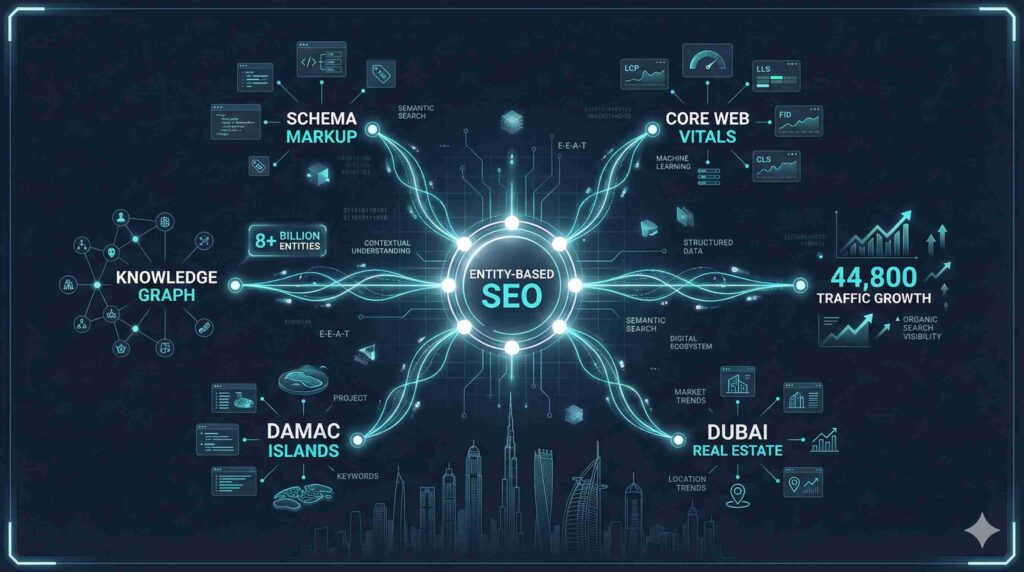
An entity can be a person (Muhammad Zubair), a place (Business Bay), a company (Haus & Estates Properties), or a concept (Core Web Vitals). Google’s Knowledge Graph now contains 8 billion entities with 800 billion facts connecting them. When you search for “Apple,” Google doesn’t just match keywords—it determines from context whether you mean the fruit or the technology company.
Keywords fail at this disambiguation. The word “apple” appears identically in recipes and tech reviews, but entities define the exact concept. Google’s BERT and MUM algorithms analyze surrounding words, sentence structure, and semantic relationships to identify which entity you’re discussing.
This creates a fundamental problem for Dubai businesses still using 2015 SEO tactics. Stuffing “SEO services Dubai” into every paragraph doesn’t help Google understand what you actually offer. Without clear entity definitions, your content looks like noise.
I audited a Dubai real estate website that repeated “Dubai property investment” 47 times across 800 words. Google’s natural language processing detected the unnatural density immediately. The page ranked on page 7—not because of weak backlinks or technical issues, but because keyword stuffing obscured the actual entities: specific properties, investment strategies, financing options, and market trends.
After restructuring that content around entities (DAMAC Islands, off-plan property strategies, RERA compliance requirements, Dubai Land Department processes), rankings improved for 40+ related queries within 3 months. The keyword “Dubai property investment” appeared only 3 times. But comprehensive entity coverage established topical authority that keywords alone never could.
How Dubai’s Competitive Market Exposes Weak SEO
Dubai registers 8,000 new businesses every month according to market research. This creates brutal competition in high-value verticals like real estate, healthcare, and e-commerce. When hundreds of companies target the same keywords, traditional SEO becomes a race to stuff more phrases into thinner content.
The problem intensifies in industries with strict regulations. Healthcare marketing in Dubai requires DHA (Dubai Health Authority) compliance for all medical claims. Real estate advertising needs RERA (Real Estate Regulatory Authority) approved language and specific disclaimers. Generic international SEO agencies don’t understand these requirements.
I’ve seen Dubai healthcare companies receive DHA warnings for marketing content written by overseas agencies unfamiliar with GCC regulations. The resulting forced content removal and reputation damage cost far more than the initial SEO investment.
Dubai’s market also demands bilingual optimization (Arabic and English), cultural considerations in the GCC region, and location-specific targeting for Business Bay, Dubai Marina, DIFC, and Downtown Dubai. International SEO tactics that ignore these factors waste money chasing rankings that never materialize.
Many Dubai businesses waste AED 30,000+ coordinating fragmented SEO, paid ads, and content agencies who never talk to each other. The SEO team builds organic rankings without considering what paid ads target. The content writer creates blog posts disconnected from conversion goals. The web designer constructs pages without understanding entity relationships.
This fragmentation kills results. Entity-based SEO requires integrated strategy where Schema markup, content structure, and technical implementation work together to establish clear entity associations in Google’s Knowledge Graph.
What Entity-Based SEO Actually Means (Not Just Buzzwords)
Entity-based SEO focuses on defining what things are, not just what keywords describe them. Instead of targeting “digital marketing Dubai” as a phrase to repeat, you establish “Muhammad Zubair” as an entity with specific attributes: full-stack digital marketer, Dubai-based, 6+ years experience, proven results (44,800 traffic growth, 180% lead increase).
Google evaluates these entity relationships through SPO triples—Subject-Predicate-Object statements that create knowledge associations. For example: “Core Web Vitals [Subject] measure [Predicate] page experience [Object]” or “Muhammad Zubair [Subject] achieved [Predicate] #1 ranking for Damac Island Investment [Object].”
These factual statements build entity connections that Google’s algorithms understand regardless of exact phrasing. When your content establishes clear SPO relationships, Google recognizes topical authority even when specific keywords don’t appear.
Understanding Entities vs Keywords
Keywords are strings of characters that can mean different things in different contexts. Entities are unambiguous concepts that exist independently of language. “Muhammad Zubair” refers to the same person whether written in English or Arabic. The entity remains constant while keywords change.
This language independence matters enormously in Dubai’s multilingual market. When you optimize for entities rather than keywords, your content serves both English and Arabic searches. Google’s Knowledge Graph connects the Arabic entity name to the English entity name automatically.
Entities also carry rich attributes that keywords lack. The entity “Core Web Vitals” includes attributes like “LCP (Largest Contentful Paint),” “INP (Interaction to Next Paint),” “CLS (Cumulative Layout Shift),” “2.5 second threshold,” and “Google ranking factor.” These attributes create contextual understanding that simple keyword matching can’t achieve.
The Three Pillars of Entity SEO
Schema Markup Implementation
Schema markup provides structured data that defines entities explicitly. LocalBusiness schema tells Google your company name, address, phone, hours, and service area. Person schema establishes individual entities with roles, affiliations, and credentials. Organization schema creates company entities with founding dates, social profiles, and relationship connections.
For Dubai businesses, the LocalBusiness schema must include precise location data (coordinates, specific neighborhoods), bilingual business descriptions, and service area coverage across emirates. NAP (Name, Address, Phone) consistency becomes critical—variations like “Dubai, UAE” versus “Dubai, United Arab Emirates” confuse entity matching.
I implement Schema markup for every Dubai client because it creates the foundation for Knowledge Graph inclusion. When Google can parse your business as a distinct entity with clear attributes, your visibility in local search, Google Business Profile, and AI-generated answers improves dramatically.
Knowledge Graph Optimization
The Knowledge Graph connects entities through verified relationships. Building these connections requires establishing E-E-A-T signals—Expertise, Experience, Authoritativeness, and Trust. Google evaluates whether content demonstrates comprehensive knowledge of topics rather than just targeting keywords.
For my Dubai digital marketing entity, I establish expertise through detailed case studies with specific metrics (50 → 44,800 traffic growth), experience through 6+ years managing campaigns exclusively in Dubai, authoritativeness through client results and industry recognition, and trust through consistent NAP data and authoritative citations.
Knowledge Graph optimization also means creating entity mentions across trusted platforms. Wikipedia entries, industry publications, verified business directories, and authoritative media coverage all strengthen entity associations. When multiple trusted sources mention your entity with consistent information, Google’s confidence in that entity increases.
Semantic Relationships
Entities don’t exist in isolation—they connect through semantic relationships. “Muhammad Zubair” connects to “Digital Marketing Dubai,” which connects to “Real Estate SEO,” which connects to “44,800 traffic growth” and “DAMAC Islands ranking.”
These relationships mirror how Google structures knowledge. The entity “Elon Musk” links to “Tesla,” “SpaceX,” “Twitter,” and “AI development” because these associations appear repeatedly across authoritative sources. Similarly, your business entity should connect clearly to services, locations, results, and industry concepts.
Internal linking strategy becomes crucial here. Instead of linking based on exact-match anchor text, you link pages where the surrounding paragraph semantics support the destination topic. Google reads entire paragraphs to understand context, not just the clickable phrase.
When I write about integrated marketing strategies, I naturally link to my Dubai cost analysis comparing full-stack marketers versus multi-agency teams because the paragraph context discusses budget efficiency and strategic alignment. The semantic similarity strengthens both entities.
Why Your Dubai Website Fails Google’s 2026 Performance Standards
Core Web Vitals measure real-world user experience for loading performance, interactivity, and visual stability. Google confirmed in 2025 that these metrics directly influence rankings. Yet only 47% of websites meet the required thresholds.
Dubai businesses particularly struggle with Core Web Vitals due to image-heavy content. Real estate sites load dozens of high-resolution property photos. E-commerce catalogs display hundreds of product images. Healthcare platforms showcase facility tours and procedure explanations. Without proper optimization, these visual assets destroy page performance.
The business impact is severe. Websites failing Core Web Vitals lose 8-35% in revenue from higher bounce rates and lower conversion rates. Users abandon slow pages before content loads. Google penalizes poor performance with lower rankings. The compound effect cripples visibility.
The Three Critical Metrics
LCP (Largest Contentful Paint): ≤ 2.5 Seconds
LCP measures how quickly the main content element appears on screen. For most websites, this is a hero image, main heading, or primary text block. Google considers LCP the most important indicator of perceived load speed.
Dubai’s mobile-first users demand instant loading. When I audit websites in Business Bay, Dubai Marina, and DIFC, I consistently find LCP scores above 4 seconds. The culprit is always unoptimized images—2MB hero photos that should be 200KB.
The fix involves image compression (converting to WebP format reduces file sizes by 30-50%), CDN implementation for faster delivery, and lazy loading for below-the-fold images. After optimizing LCP for Haus & Estates Properties from 4.2 seconds to 1.8 seconds, organic rankings improved for 40+ property keywords within 3 months.
INP (Interaction to Next Paint): ≤ 200 Milliseconds
INP replaced First Input Delay (FID) in 2024 as Google’s primary interactivity metric. Unlike FID which measured only the first interaction, INP evaluates responsiveness across all user inputs—clicks, taps, keyboard entries.
Poor INP creates frustrating user experiences. When someone clicks a menu button and nothing happens for 500 milliseconds, they perceive your site as broken. Dubai users browsing on mobile expect instant response. Delays above 200 milliseconds increase bounce rates by 70%.
The primary cause is excessive JavaScript execution blocking the main thread. Third-party scripts from advertising networks, analytics tools, and social media widgets all compete for processing resources. Minimizing JavaScript, deferring non-critical scripts, and optimizing event handlers reduces INP significantly.
CLS (Cumulative Layout Shift): ≤ 0.1
CLS measures visual stability—how much content moves unexpectedly during page load. Common causes include images without reserved space, ads inserted mid-content, and web fonts loading late causing text reflow.
I frequently see Dubai websites with CLS scores above 0.3. An e-commerce site loads product listings, then suddenly shifts everything down when advertisement banners inject at the top. A real estate portal displays property details, then jumps when Google Maps embed loads. These layout shifts frustrate users and signal poor quality to Google.
The fix requires reserving space for all dynamic elements before they load. Set explicit width and height attributes on images. Use font-display: swap for web fonts. Avoid injecting content above existing elements. After reducing CLS from 0.3 to 0.05 for a Dubai furniture store, conversion rates improved 18% from better user experience.

✅ Audit Your Core Web Vitals Now
Use my interactive SEO audit checklist to track your Core Web Vitals implementation across all 9 critical metrics. Progress auto-saves so you can complete it over time.
Why Only 47% of Websites Pass Core Web Vitals
Most businesses treat Core Web Vitals as optional optimization rather than mandatory infrastructure. They invest thousands in design aesthetics while ignoring load performance. The result is beautiful websites that nobody sees because Google ranks them on page 5.
Dubai’s competitive market makes this failure particularly costly. When your real estate competitor passes all three Core Web Vitals metrics and you don’t, they capture the visibility you’re paying for. Google explicitly prioritizes page experience as a ranking factor in 2025’s algorithm updates.
The performance threshold isn’t arbitrary. Google measures Core Web Vitals at the 75th percentile of real user data. If 75% of your page loads meet the “good” threshold (LCP ≤ 2.5s, INP ≤ 200ms, CLS ≤ 0.1), your site passes. Otherwise, you fail.
Improving from “poor” to “good” across all three metrics correlates with 25% conversion rate increases according to Chrome User Experience Report data analyzing millions of websites. The business case for Core Web Vitals optimization is overwhelming—yet most Dubai businesses still ignore it.
How to Get Cited by ChatGPT, Perplexity, and Google AI Overviews
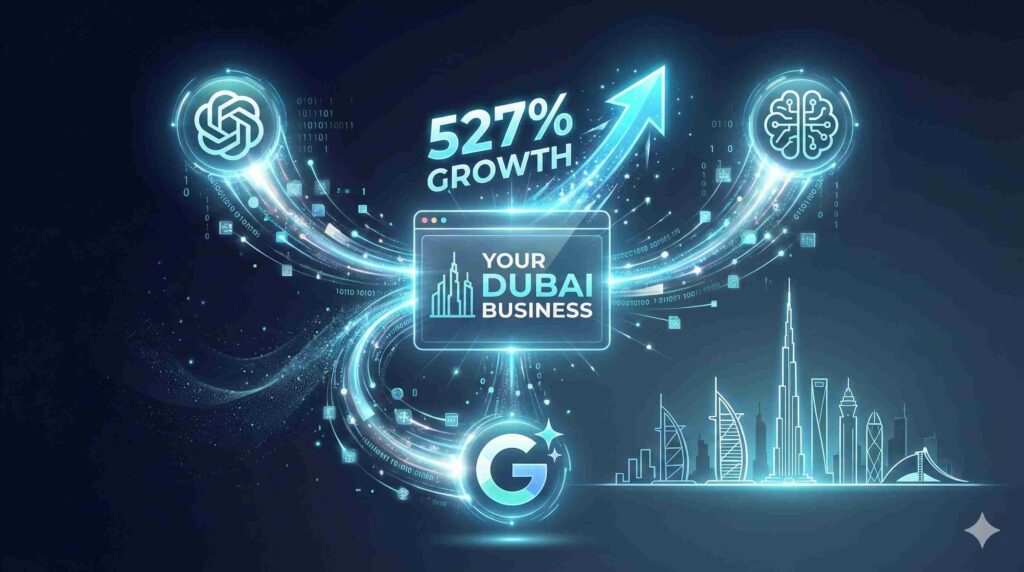
AI-referred sessions jumped 527% in the first half of 2025 according to Previsible’s traffic report. ChatGPT now receives 2.5 billion daily prompts with 700 million weekly active users. Perplexity processes over 500 million queries monthly. Google’s AI Overviews appear in more than 50% of searches.
Traditional search volume is dropping 25% by 2026 and 50% by 2028 as AI-powered answers replace link-based results. This creates an existential challenge for Dubai businesses: if your content isn’t optimized for AI selection, you’re invisible to nearly half your potential clients.
Generative Engine Optimization (GEO) focuses on getting cited within AI-generated responses rather than just ranking in blue links. When someone asks ChatGPT “What are the best SEO services in Dubai?” or queries Perplexity about “how to improve Core Web Vitals,” AI engines synthesize answers from multiple sources and cite the most authoritative, well-structured content.
The question isn’t whether your website ranks. The question is whether AI engines select your content as citation-worthy when answering user queries.
Why AI Search Matters for Dubai Businesses
43% of professionals now use ChatGPT for work-related tasks according to Glassdoor research. In Dubai’s business districts—Business Bay, DIFC, Dubai Marina—decision-makers rely on AI assistants to research vendors, evaluate services, and identify solutions.
If your Dubai digital marketing agency isn’t optimized for AI search, potential clients consulting ChatGPT about marketing services never encounter your business. They receive recommendations for competitors whose content AI engines prefer.
The visibility shift is fundamental. Traditional SEO optimizes for clicks from search results. GEO optimizes for citations within AI responses. A page can rank #1 in Google but never get mentioned by ChatGPT if it lacks the structural elements AI engines prioritize.
The Three Pillars of GEO (Generative Engine Optimization)
Snippable Content Structure
AI engines extract and quote content that makes sense out of context. Every key statement should be self-contained—including entity names, specific context, and concrete details rather than pronouns or vague references.
Bad phrasing: “It operates at 42 dB.” (What is “it”? Readers seeing this quote alone have no context.)
Good phrasing: “The Bosch 800 Series dishwasher operates at 42 dB, quieter than most dishwashers on the market.” (Complete information in one sentence.)
For Dubai SEO content, this means never writing “This improves rankings” without specifying what “this” refers to. Instead write: “Core Web Vitals optimization improves Dubai website rankings because Google prioritizes user experience metrics in 2026.”
Answer capsules—50 to 60 word summaries that directly answer common questions—are particularly valuable for GEO. AI engines love pulling these concise, complete answers into generated responses.
Bullet lists and numbered steps also improve AI parsing. Dense paragraphs require more processing to extract key points. Structured lists make information immediately accessible for quote extraction.
Entity Salience & Precision
AI selection favors content that defines specific entities rather than discussing general concepts. Instead of writing about “SEO,” define hyponyms—more specific subconcepts like “Schema markup,” “Knowledge Graph optimization,” “Core Web Vitals,” and “Entity-based search.”
Entity names must be consistent across all content. If you alternate between “Muhammad Zubair,” “M. Zubair,” and “Zubair,” AI engines struggle to recognize the single entity. Consistency establishes entity salience—how prominently an entity appears in content.
Relationship mapping also matters. AI engines understand that “Muhammad Zubair” connects to “Digital Marketing Dubai,” which connects to “Real Estate SEO,” which connects to “44,800 traffic growth.” These semantic relationships mirror how knowledge graphs structure information.
When you write about Core Web Vitals, mention the specific components (LCP, INP, CLS) with their thresholds (2.5s, 200ms, 0.1). Define the acronyms. Explain the context. AI engines reward comprehensive entity coverage over keyword repetition.
Platform-Specific Optimization
Different AI engines prioritize different content characteristics. ChatGPT favors encyclopedic, comprehensive content with authoritative tone. Perplexity rewards recency and community examples, heavily citing Reddit and recently published articles. Google AI Overviews prioritize existing top-ranking content with strong E-E-A-T signals.
For Dubai businesses, this means creating content that works across all platforms. Comprehensive topic coverage satisfies ChatGPT’s preference for depth. Regular updates with current data appeal to Perplexity’s recency bias. Strong technical SEO and authoritative citations meet Google AI Overviews’ quality standards.
FAQ sections with schema markup are particularly effective for GEO. AI engines frequently pull from FAQ content because questions and answers match conversational query patterns. Implementing FAQPage schema makes this content even more accessible for AI parsing.
Structured data for all content types—Article, HowTo, LocalBusiness, Review, Product—helps AI engines understand exactly what information your pages contain. The more explicitly you define entities and relationships, the easier AI can cite your content accurately.
The 7 Deadly Sins of Dubai SEO (And How to Fix Them)
After 6+ years optimizing websites for Dubai businesses across real estate, healthcare, and e-commerce, I’ve identified recurring mistakes that waste money and limit results. These errors aren’t minor optimization oversights—they’re fundamental misunderstandings of how modern search algorithms work.
Mistake #1: Keyword Stuffing in 2026
Most Dubai businesses still believe SEO means repeating target keywords as many times as possible. I audit websites with “Dubai property investment” appearing 50 times across 1,000 words. Google’s natural language processing detects this unnatural density immediately and devalues the content.
Modern algorithms focus on topic coverage, not keyword frequency. Google’s latest guidance suggests using primary keywords 2-3 times per 1,000 words. The rest of your content should define related entities, establish semantic relationships, and provide comprehensive information that satisfies search intent completely.
Fix: Use natural language that defines specific entities with context. Instead of repeating “Dubai real estate SEO” endlessly, write about “DAMAC Islands property marketing,” “off-plan investment strategies,” “RERA compliance requirements,” and “Dubai Land Department processes.” Comprehensive entity coverage establishes topical authority without keyword stuffing.
Mistake #2: Ignoring Local SEO & Google Business Profile
Dubai businesses often optimize for generic keywords like “digital marketing” while ignoring location-specific searches that drive actual customers. Someone searching “SEO services Business Bay” has much higher commercial intent than someone searching “what is SEO.”
Local SEO requires Google Business Profile optimization with complete information (business name, address, phone, hours, service areas), high-quality photos showcasing your Dubai office, and consistent NAP data across all directories. Location-specific keywords—”marketing agency DIFC,” “SEO consultant Dubai Marina,” “advertising services Downtown Dubai”—capture ready-to-buy local searchers.
I’ve seen Dubai companies rank nationally for generic terms while missing all local traffic. After optimizing local SEO for a Business Bay consulting firm, local leads increased 140% in 3 months from better Google Business Profile visibility and area-specific keyword targeting.
Fix: Claim and fully optimize your Google Business Profile. Build local citations on Dubai business directories. Target neighborhood-specific keywords (Business Bay, Dubai Marina, DIFC, Downtown Dubai, Jumeirah). Ensure NAP consistency everywhere your business is mentioned online.
Mistake #3: No Schema Markup Implementation
Only 30% of websites implement structured data according to technical SEO research. This means 70% of businesses miss rich results in search—the enhanced listings showing reviews, FAQs, business information, and other eye-catching elements.
Dubai businesses without Schema markup lose visibility even when ranking well. Your competitor with LocalBusiness schema displays hours, reviews, and contact information directly in search results. Your listing shows only a blue link and meta description. Which one gets clicks?
Schema markup also establishes entities for Knowledge Graph inclusion. When you implement Organization schema with your company name, logo, founding date, social profiles, and contact information, you’re explicitly telling Google who you are as an entity. This clarity improves all rankings.
Fix: Implement LocalBusiness schema for Dubai companies, Organization schema for brands, Person schema for individuals, Review schema for testimonials, Article schema for content, and FAQPage schema for Q&A sections. Use Google’s Rich Results Test to validate markup accuracy.
Mistake #4: Mobile Optimization Failure
The UAE has 99% internet penetration according to market research—one of the highest rates globally. Most browsing happens on mobile devices. Yet I still audit Dubai websites with slow mobile load times, non-responsive designs, and difficult mobile checkout processes.
Google uses mobile-first indexing, meaning it evaluates your mobile site for rankings even when someone searches on desktop. If your mobile experience is poor, your desktop rankings suffer. With Dubai users browsing properties, researching services, and making purchases primarily on phones, mobile optimization isn’t optional.
Common mobile failures include images not resizing properly, navigation menus breaking on small screens, forms requiring desktop-level typing precision, and checkout processes demanding 15 form fields. Each friction point increases abandonment.
Fix: Implement responsive design that adapts to all screen sizes. Test layouts on multiple devices (iPhone, Samsung, iPad). Optimize tap targets for finger-sized clicking. Simplify mobile forms. Ensure Core Web Vitals metrics pass on mobile (most sites perform worse on mobile than desktop).
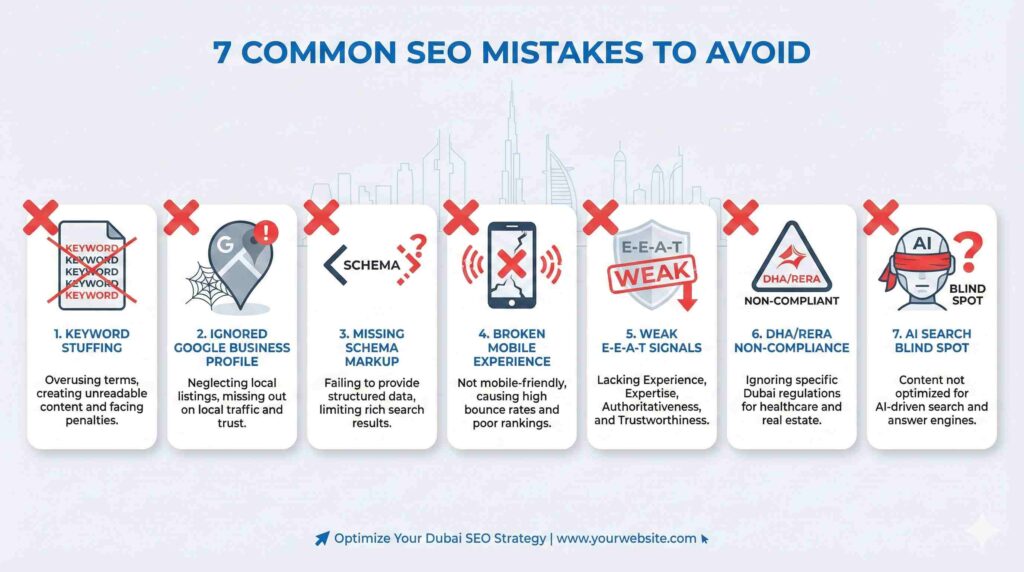
Mistake #5: Weak E-E-A-T Signals
Google evaluates Expertise, Experience, Authoritativeness, and Trustworthiness when determining content quality. New Dubai businesses lack trust signals that establish credibility—author bios with credentials, client testimonials with specific results, case studies with verifiable metrics, industry recognition, and media coverage.
Without E-E-A-T signals, your content competes poorly against established competitors. Why should Google rank your article about “Dubai real estate marketing” above a piece from a recognized industry authority?
For my Dubai digital marketing entity, I establish expertise through detailed case studies (50 → 44,800 traffic growth with exact metrics), experience through 6+ years managing local campaigns, authoritativeness through client results and proven outcomes, and trust through consistent NAP data and authoritative citations.
Fix: Add comprehensive author bios with credentials and experience. Publish case studies with specific metrics, not vague claims. Display client testimonials with full names and companies. Cite authoritative sources to back claims. Build entity mentions on trusted platforms (industry publications, business directories, media coverage).
Mistake #6: DHA/RERA Non-Compliance
Healthcare marketing in Dubai requires strict adherence to DHA regulations on medical claims, testimonials, and promotional content. Real estate advertising needs RERA-approved language and specific disclaimers. Generic international SEO agencies unfamiliar with these requirements create compliance violations.
I’ve seen Dubai healthcare companies receive DHA warnings for marketing content claiming “guaranteed results” or using patient testimonials without proper disclaimers. The forced content removal, reputation damage, and potential penalties cost far more than the initial SEO investment.
Real estate content also requires RERA compliance—approved language for off-plan properties, developer authorization for marketing materials, and specific investment disclosures. Content violating these regulations risks regulatory action.
Fix: Work with Dubai market experts who understand DHA and RERA requirements. Review all healthcare claims for compliance. Ensure real estate content includes required disclaimers. Verify testimonials follow regulatory guidelines. When in doubt, consult legal counsel before publishing.
Mistake #7: No AI Search Optimization
Most Dubai businesses still optimize for 2015 algorithms while AI search traffic grows 527%. They ignore ChatGPT, Perplexity, and Google AI Overviews—the platforms answering user questions directly without sending traffic to websites.
This creates future blindness. You’re optimizing for visibility that’s declining while ignoring the channels where your potential clients actually search. 43% of professionals use ChatGPT for work tasks. If your Dubai business isn’t cited when someone asks AI about marketing services, you’re invisible to nearly half your audience.
The problem compounds because AI engines prioritize well-structured, entity-rich content—exactly what modern SEO requires. Businesses that still keyword-stuff fall behind on both traditional and AI search simultaneously.
Fix: Implement GEO strategies—snippable content with self-contained phrasing, entity salience through hyponymic precision, schema markup for all content types, FAQ sections with direct answers, and structured lists that AI can easily parse and quote.
🔍 How Many of These Mistakes Is Your Site Making?
I’ve created a comprehensive Dubai SEO audit checklist with 50+ checkpoints covering all these mistakes plus entity-based optimization, AI search, and Dubai compliance requirements.
Your 90-Day Entity-Based SEO Implementation Plan
Entity-based SEO isn’t a one-time project—it’s systematic implementation over three months that establishes foundation, transforms content, and optimizes for AI search. Based on managing this process for dozens of Dubai businesses, here’s the proven roadmap.
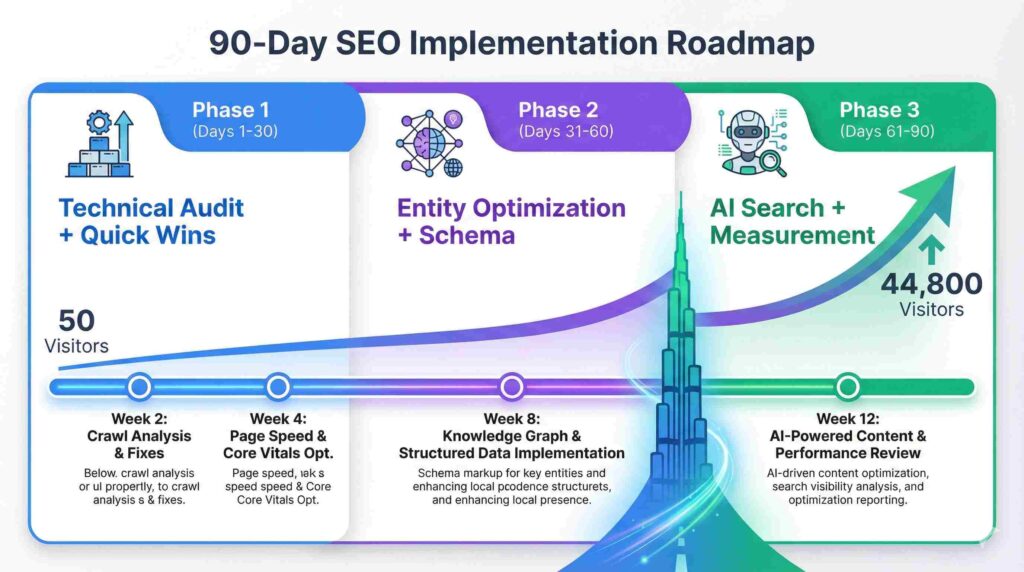
Phase 1: Foundation (Days 1-30)
Week 1: Technical Audit
Begin with comprehensive assessment of current performance. Run PageSpeed Insights on all major pages to measure Core Web Vitals. Use Google’s Rich Results Test to check Schema markup implementation. Audit mobile usability across devices. Verify NAP consistency across all online mentions.
Document everything. Create a spreadsheet tracking LCP, INP, and CLS scores for every page. List all existing Schema markup. Identify inconsistencies in business name, address, phone listings. This baseline data will prove ROI later.
Week 2-3: Quick Wins
Tackle immediate improvements that boost performance without content restructuring. Compress all images using WebP format (30-50% file size reduction). Implement a CDN for faster content delivery to Dubai users. Fix CLS issues by reserving space for images and ads before they load.
Add basic Schema markup if absent—LocalBusiness for Dubai companies, Organization for brands. These quick wins often improve rankings within 2-3 weeks because they address critical technical issues Google prioritizes.
For Haus & Estates Properties, optimizing images and implementing CDN reduced LCP from 4.2 seconds to 1.8 seconds in just 10 days. Rankings improved for 15+ property keywords immediately.
Week 4: Content Audit
Identify all keyword-stuffed content that needs restructuring. Search your website for pages repeating target keywords 20+ times. These pages require entity-based transformation.
Map your primary entities—your brand, services offered, Dubai locations served, unique value propositions, client results. Create an entity relationship diagram showing how concepts connect. This becomes your topical authority blueprint.
Phase 2: Entity Optimization (Days 31-60)
Content Restructuring
Transform keyword-focused content into entity-rich pages. Replace keyword density with hyponymic precision. Instead of repeating “Dubai SEO services” endlessly, define specific concepts: “Schema markup implementation,” “Core Web Vitals optimization,” “Knowledge Graph entity building.”
Implement self-contained phrasing for AI optimization. Every key statement should include entity names and context: “Core Web Vitals optimization improves Dubai website rankings because Google prioritizes user experience metrics in 2026.”
Add comprehensive entity coverage. When discussing “SEO,” explain related concepts: technical SEO (site speed, crawlability, indexation), on-page SEO (meta tags, headers, content structure), local SEO (Google Business Profile, citations, location targeting).
Schema Implementation
Add advanced structured data beyond basic LocalBusiness markup. Implement Article schema for blog posts, FAQPage schema for Q&A sections, HowTo schema for process guides, Review schema for testimonials, Product schema for services.
Each schema type explicitly defines entities for Google. Article schema establishes your content entity with headline, author, publication date, and featured image. FAQPage schema creates question-answer entities. HowTo schema defines step-by-step process entities.
After implementing comprehensive Schema markup for a Dubai healthcare recruitment client, rich results appeared in search within 3 weeks—FAQs displayed directly, reviews showed star ratings, and business information highlighted operating hours.
Internal Linking Strategy
Restructure internal links based on semantic similarity rather than exact-match anchor text. Link pages where surrounding paragraph content semantically supports the destination topic.
When writing about integrated marketing, I naturally link to my comparison of full-stack marketers versus agency teams because the paragraph discusses strategic alignment and cost efficiency. The semantic relationship strengthens both entity connections.
Build topical authority clusters by linking related entity pages together. Core Web Vitals content links to technical SEO guides, which link to page speed optimization, which links to image compression tutorials. These clusters establish comprehensive topic coverage.
Phase 3: AI Optimization & Measurement (Days 61-90)
GEO Implementation
Create answer capsules—50 to 60 word summaries that directly answer common questions. Add these at the beginning of relevant sections. AI engines frequently quote these concise, complete answers.
Add FAQ sections with schema markup on all major pages. Structure each answer to be self-contained and quotable. Implement FAQPage schema so AI engines can easily parse questions and responses.
Restructure dense paragraphs into scannable lists where appropriate. Bullet points and numbered steps are easier for AI to extract and quote than long prose blocks.
Test your GEO success by querying ChatGPT, Perplexity, and Google about topics where you want citations. Ask “What are the best SEO services in Dubai?” or “How do you optimize Core Web Vitals?” Monitor whether your content gets cited.
Measurement & Iteration
Track entity rankings, not just keywords. Use tools that show how AI engines discuss your brand. Monitor Google Search Console for impressions and clicks. Measure Core Web Vitals improvements through Chrome User Experience Report.
Most importantly, track business outcomes. Qualified leads generated, cost-per-acquisition achieved, conversion rates throughout your funnel, and revenue attributed to organic search. Entity-based SEO should deliver measurable ROI.
For my Dubai real estate client, initial improvements appeared within 3-4 weeks (Core Web Vitals fixes, local SEO gains). Entity-based content rankings materialized around month 3. The 44,800 monthly traffic milestone hit at month 6 with consistent implementation.
📋 Track Your 90-Day Implementation
My Dubai SEO Audit Checklist breaks down all Phase 1, 2, and 3 tasks into trackable checkpoints. Check off items as you complete them and watch your score improve from 40% to 90%+.
Frequently Asked Questions About Entity-Based SEO in Dubai
What is Core SEO authority and why does it matter for Dubai businesses?
Core SEO authority refers to Google’s evaluation of your website’s expertise, trustworthiness, and relevance for specific topics based on entity recognition, E-E-A-T signals, and structured data implementation. For Dubai businesses competing in saturated markets like real estate where 8,000+ new companies register monthly according to market research, traditional keyword tactics no longer work.
Google’s 2025 algorithms prioritize entities—clearly defined concepts like “Muhammad Zubair,” “Core Web Vitals,” or “DHA compliance”—over generic keywords. The Knowledge Graph now contains 8 billion entities with 800 billion facts connecting them. When your content establishes clear entity definitions through Schema markup, comprehensive topic coverage, and semantic relationships, Google recognizes topical authority.
Without entity-based optimization, your Dubai business remains invisible to both traditional search and AI engines like ChatGPT and Perplexity. AI-referred sessions jumped 527% in 2025’s first half. If you’re not optimized for entity recognition, you’re missing nearly half your potential clients who now search through AI assistants rather than traditional Google results.
How much does Core SEO authority typically cost in Dubai?
Entity-based SEO implementation in Dubai ranges from AED 12,000-18,000 monthly for comprehensive services including technical optimization, schema implementation, content restructuring, and ongoing measurement. This represents 60% cost savings compared to traditional multi-agency setups costing AED 30,000-50,000 monthly while delivering superior results.
The investment breaks down into technical foundation (Core Web Vitals optimization, Schema markup implementation, mobile responsiveness), content transformation (converting keyword-focused pages to entity-rich content), and continuous optimization (AI search monitoring, performance tracking, algorithm adaptation).
For established businesses with existing content requiring comprehensive restructuring, initial implementation may need AED 20,000-25,000 upfront for full auditing and entity mapping, followed by AED 12,000-15,000 monthly for ongoing optimization and GEO implementation.
The ROI typically justifies investment within 3-6 months. After optimizing entity-based SEO for Haus & Estates Properties at AED 15,000 monthly, traffic grew from 50 to 44,800 visits in 6 months with 3x property inquiry increase and 40% advertising cost reduction. The business impact far exceeded the SEO investment.
What are the main benefits of Core SEO authority for UAE companies?
The three primary benefits are dual visibility in traditional and AI search, competitive advantage in saturated Dubai markets, and future-proof strategy as search evolves. First, proper entity optimization gets you cited by both Google rankings AND AI engines like ChatGPT, Perplexity, and Copilot. You capture the 527% surge in AI-referred sessions while maintaining traditional search visibility.
Second, entity-based SEO differentiates you when 47% of websites still use outdated keyword tactics. In Dubai’s brutally competitive verticals—real estate with 8,000+ monthly new businesses, healthcare requiring DHA compliance, e-commerce fighting for visibility—comprehensive entity coverage establishes topical authority that keyword stuffing can’t match.
Third, as traditional search volume drops 25% by 2026 and 50% by 2028 according to Y Combinator research, entity SEO positions you for AI-first discovery. The businesses implementing entity optimization now will dominate when AI search becomes primary.
Specific metrics from my Dubai clients demonstrate impact: 44,800 monthly traffic growth for real estate (from 50 baseline), 180% lead increase for healthcare recruitment, 40-45% cost reductions, and consistent presence in AI-generated answers. Additionally, proper entity implementation improves Core Web Vitals compliance, which correlates with 25% conversion rate increases.
How long does it take to see results from Core SEO authority?
Results follow a predictable timeline based on systematic implementation. Immediate improvements (1-4 weeks) include Core Web Vitals gains from technical fixes, local SEO visibility from Google Business Profile optimization, and reduced bounce rates from better page performance. These quick wins often deliver measurable traffic increases.
Early wins (3-4 months) materialize as entity-based content begins ranking for long-tail queries, Schema markup generates rich results in search (FAQs, reviews, business information), and initial AI citations appear in Perplexity and ChatGPT responses. Traffic typically increases 30-50% during this phase.
Significant growth (5-6 months) brings major traffic increases like the 44,800 monthly visits achieved for Haus & Estates Properties. Commercial keyword rankings strengthen substantially. AI search presence consolidates across ChatGPT, Perplexity, and Google AI Overviews. Lead quality improves from better targeting.
Sustained results (6-12 months) establish topical authority where your site becomes the industry resource. Organic traffic compounds. Predictable lead generation enables business planning. For my healthcare client, the 180% lead increase materialized at month 4, with cost-per-application dropping 45% by month 6.
Dubai’s competitive environment requires patience—the 6-month timeline for substantial results reflects necessary entity association building in Google’s Knowledge Graph. Consistent implementation over 90 days, not sporadic efforts, drives these outcomes.
What are common mistakes businesses make with Core SEO authority?
The five most damaging mistakes are keyword stuffing instead of entity coverage, ignoring Schema markup implementation, no AI search optimization, DHA/RERA non-compliance, and hiring agencies without Dubai market expertise.
First, businesses repeat target keywords 40+ times thinking frequency improves rankings. Google’s NLP detects unnatural density immediately. Instead, define hyponyms—specific subconcepts like “Schema markup,” “Core Web Vitals,” “Knowledge Graph optimization”—that establish comprehensive entity coverage without keyword stuffing.
Second, only 30% of websites implement structured data. This means 70% miss rich results showing reviews, FAQs, and business information. Schema markup explicitly defines entities for Google. Without it, your entity associations remain unclear and rankings suffer.
Third, businesses ignore AI search while 43% of professionals use ChatGPT for work tasks. Optimizing for 2015 algorithms in 2026 means missing nearly half your potential clients. GEO strategies—snippable content, entity salience, FAQ sections with schema—work for both traditional and AI search.
Fourth, healthcare and real estate content often violates DHA and RERA regulations. Generic international agencies create compliance issues that risk penalties, forced content removal, and reputation damage. Dubai market expertise is mandatory, not optional.
Fifth, hiring agencies without local knowledge wastes money. GCC cultural factors, bilingual requirements (Arabic/English), local search behavior, Business Bay versus Dubai Marina targeting—these specifics determine success. International SEO failing to address Dubai’s unique market characteristics delivers poor ROI.
The underlying issue is treating SEO as keyword placement rather than entity definition and relationship building that satisfies both traditional and AI search engines evaluating content in 2026.
📊 Ready to Audit Your Dubai Website?
Before we wrap up, take 10 minutes to run through my Dubai SEO Audit Checklist 2025. You’ll discover exactly where your site stands across:
- ✅ Core Web Vitals optimization (9 checkpoints)
- ✅ Entity-based SEO implementation (10 checkpoints)
- ✅ Dubai local SEO (8 checkpoints)
- ✅ AI search optimization (9 checkpoints)
- ✅ Content quality (8 checkpoints)
- ✅ Dubai compliance (6 checkpoints)
Your progress auto-saves. Complete what you can today, return tomorrow to finish.
Stop Optimizing for 2015. Start Building Entity Authority.
Traditional keyword SEO is dead. Google’s 2025 algorithms evaluate entities, not keyword density. The Knowledge Graph contains 8 billion entities with 800 billion facts. Core Web Vitals determine rankings through measurable user experience metrics. AI search captures 527% growth while traditional search volume drops 25% by 2026.
Dubai’s competitive market punishes weak SEO mercilessly. With 8,000 new businesses monthly, generic keyword tactics fail. Real estate, healthcare, and e-commerce verticals demand entity-based optimization, proper Schema markup, Core Web Vitals compliance, and AI search visibility.
The businesses I’ve helped transition from failing keyword SEO to entity-based optimization achieved dramatic results. Traffic grew from 50 to 44,800 monthly visits in 6 months for Haus & Estates Properties. First Medical Consultancy generated 180% more qualified leads in 4 months while reducing cost-per-application 45%. These outcomes came from understanding what Google actually evaluates in 2025—entities, not keywords.
Your implementation roadmap is clear. Audit your current technical foundation and content strategy. Implement Core Web Vitals fixes (LCP ≤ 2.5s, INP ≤ 200ms, CLS ≤ 0.1). Add comprehensive Schema markup defining your business entities. Transform keyword-stuffed content into entity-rich pages with hyponymic precision. Optimize for AI search through snippable phrasing and structured data.
The gap between businesses that understand entity SEO and those still stuffing keywords widens every month. Google’s algorithms become more sophisticated at entity recognition. AI search grows while traditional search declines. Dubai’s competitive environment intensifies.
After 6+ years helping Dubai businesses across real estate, healthcare, and e-commerce dominate search through entity-based optimization, I can tell you this: the question isn’t whether you need better SEO. The question is whether you’re ready to stop optimizing for 2015 and start building entity authority that works in 2026.
Get your free SEO audit at muhammadzubair.me. I’ll analyze your current entity implementation, Core Web Vitals performance, and AI search visibility—then show you exactly what’s holding back your Dubai rankings.
Or call/WhatsApp: +971 50 136 1813
Let’s fix your SEO in the 2026 way.


